Bite-size cake cubes have become one of the fastest-growing formats in bakery and confectionery retail: brownie bites, flapjack cubes, dessert cups and mixed-portion trays for food service all depend on a cube that holds its shape, carries clean faces and weighs consistently. Cube cutting is also the hardest cutting operation in a bakery, because it requires the product to be divided twice — across and along — while each small piece remains intact. The Wanlisonic Ultrasonic Cube Cake Cutting Machine is built specifically for this task, combining two-axis ultrasonic cutting with programmable cube dimensions and an optional in-line cleaning and disinfecting unit that keeps production running.
Why Cube Cutting Is Harder Than Slicing
Slicing a cake slab into portions is a single-direction operation. Cube cutting multiplies the difficulty, because the product is cut twice and the smallest pieces must survive both passes:
- Two cutting directions are needed, which doubles the handling between stages
- Cream, jam and soft fillings smear across four faces of every cube rather than one
- Sticky products adhere to the blade, distorting the cube outline
- Cut cubes can collapse or lean when they are separated after the cross-cut
- Crumbs and debris build up quickly, forcing cleaning stops
- Manual cutting of small cubes is slow, labour-intensive and inconsistent in size
- Portion weight varies, which complicates packing and pricing
For manufacturers supplying snack packs, catering trays and dessert assortments, these issues determine whether a cube product is commercially viable at all.
Two-Axis Cutting: How Cubes Are Actually Formed
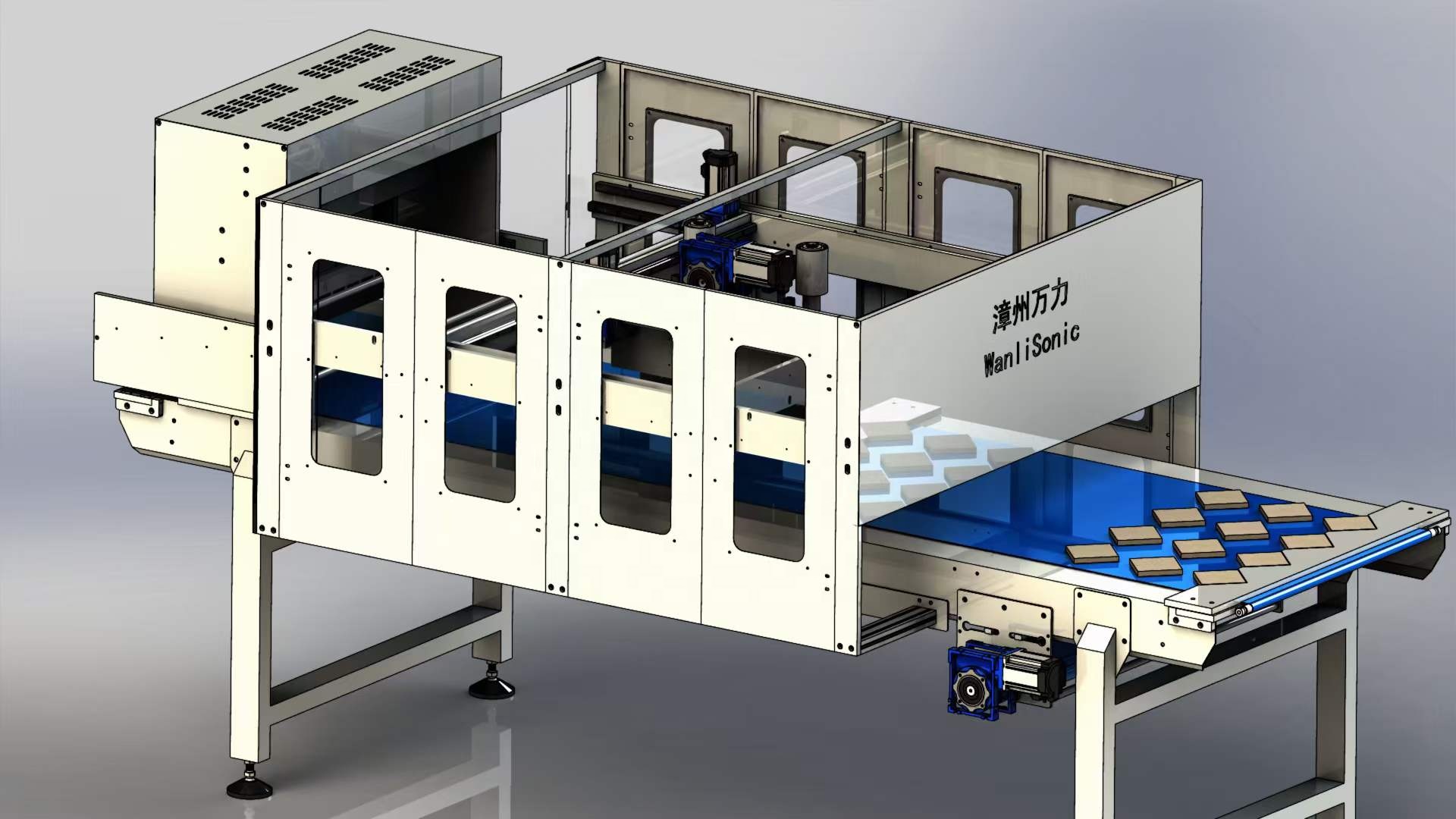
The Wanlisonic cube cutting design performs the operation in two coordinated passes. Cross cutting runs at up to 60 cuts per minute, and slitting runs at 30 cuts per minute — the two directions that together produce a cube rather than a strip or a slice. The blade is driven by an ultrasonic chain: a generator produces the high-frequency electrical signal, a transducer converts it into mechanical vibration, and the vibration travels through the blade to the cutting edge. Cube and small-cube machines in this class typically operate at frequencies in the 20 to 40 kHz range.
Because the blade vibrates rather than presses, resistance and friction at the cut fall to a minimum. The blade separates the product instead of compressing it, so delicate sponge, layered fillings and sticky surfaces pass through the cut without being crushed — which is precisely what allows small cubes to emerge with clean, defined edges on all faces.
Programmable Cube Sizes and Controlled Portions
Cube size is adjustable, so the same machine can serve a snack-pack format, a catering tray or a premium dessert assortment without mechanical rebuilding. Cutting parameters are entered in advance, and the automated system then feeds, positions and cuts the product accordingly. The outcome is a controlled portion size that repeats across the shift — the basis for reliable packing weights and consistent retail presentation. The machine handles both chilled and ambient-temperature products with the same cut quality and repeatability, so a single line can cover products held at different stages of the process.
One Machine for Sweet and Savoury Products
Cube cutting is not limited to sweet bakery. The Wanlisonic system is designed to handle both savoury and sweet products — from pies, quiches and pizzas through to cakes, pastries, flapjacks and brownies. It is equally suited to cutting strip and block products, which makes it useful to manufacturers running mixed portfolios on the same equipment. That flexibility matters commercially: a single capital investment covers several product families instead of one.
In-Line Cleaning: Cutting Without Interruption
Blade cleaning is one of the most underestimated costs in sticky-product cutting. Every cleaning stop interrupts the flow, consumes labour and reduces output. Wanlisonic addresses this directly with an optional cleaning and disinfecting unit: the cutting process does not need to be interrupted for knife cleaning, and no manual cleaning of the blade is required during production. The result is safer, more hygienic operation with more productive hours per shift — a practical advantage in continuous multi-shift environments.
Reduced Scrap and Higher Yield
Ultrasonic cutting minimises the crumbling, tearing and deformation that generate scrap in conventional cube cutting. Wanlisonic’s design further reduces food scraps, which in turn reduces the downtime otherwise spent cleaning the production system — a compounding benefit where waste and cleaning time reinforce each other. For products where the raw material cost is significant, the yield improvement alone can justify the investment.
The Machine in Detail
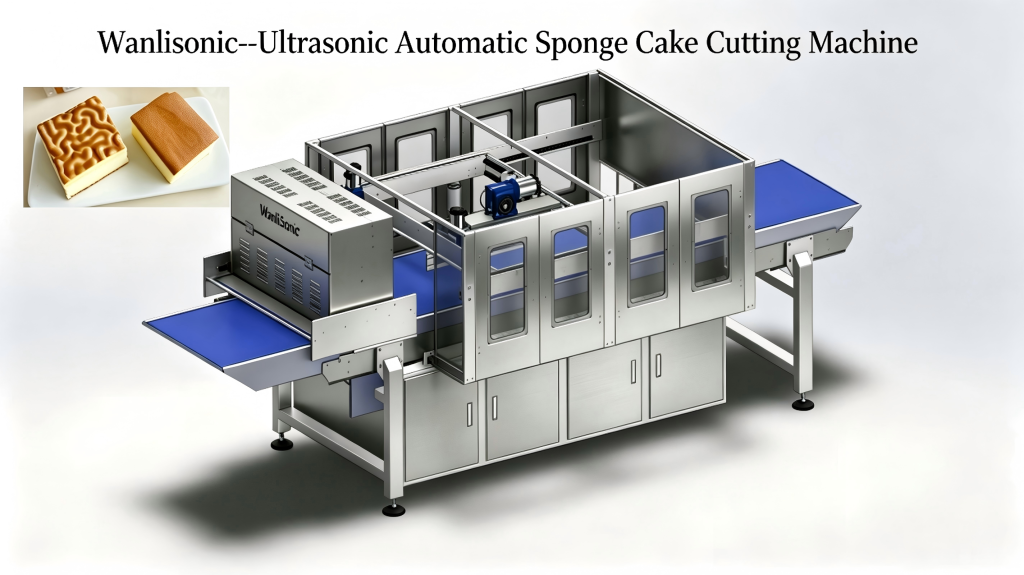
Representative specification of the Wanlisonic small cube cake cutting machine:
- Model: Wanlisp4-300K900L3500
- Dimensions: L3000 × W1400 × H1600 mm
- Weight: net 500 kg, gross 600 kg
- Voltage and power: 220 V, 5000 W
- Power frequency: 50–60 Hz
- Cutting speed: cross cutting 60 cuts per minute, slitting 30 cuts per minute
- Blade material: titanium alloy
- Machine frame: stainless steel
The platform incorporates automated systems for product feeding, positioning and cutting, minimising manual intervention and supporting medium and large food manufacturers.
Where Cube Cutting Pays Off
The machine is used across a range of production environments where cube and small-cube portions are part of the product range:
- Food manufacturing facilities producing packaged cube products
- Commercial bakeries supplying retail and food service
- Confectionery companies running cube and bite-size formats
- Frozen food manufacturers portioning chilled and frozen products
- Restaurant chains requiring standardised portion sizes
- Specialty dessert shops producing mixed assortments
In each case the commercial logic is the same: consistent cubes reduce giveaway, protect presentation and remove repetitive manual work from the line.
Customization and Product Testing
Cube dimensions, cutting patterns, capacity and automation level can be configured to the customer’s product range, and the production line can be discussed as a whole so that feeding and downstream handling suit the cutting stage. Because dough and cake formulations behave differently — fat content, temperature, filling viscosity and topping all influence results — product testing is recommended before the machine specification is confirmed.
More Than 20 Years in Ultrasonic Food Cutting
Wanlisonic has specialised in ultrasonic food cutting machinery for more than 20 years, with an in-house R&D team and global after-sales support. Machines are supplied to more than 1,000 clients and exported to Europe, the United States, the Middle East, Southeast Asia, Oceania and other markets across cake, bread, cookie, sandwich, cheese, confectionery and frozen food applications.
Conclusion
As bite-size and portion-controlled formats keep expanding in bakery retail and food service, cube cutting has moved from a niche operation to a core production requirement. The Wanlisonic Ultrasonic Cube Cake Cutting Machine answers it with two-axis ultrasonic cutting, adjustable cube dimensions, sweet and savoury capability and an in-line cleaning option that removes blade cleaning from the production schedule. For manufacturers producing cube products at volume, the new demonstration video shows how the technology performs in practice.
FAQ
1. What is an ultrasonic cube cake cutting machine?
It is an automated cutting system that divides cake and bakery products in two directions to produce uniform cubes, using a blade that vibrates at high frequency (typically 20 to 40 kHz) to cut cleanly without crushing or smearing. See the Wanlisonic small cube cake cutting machine page for specifications.
2. How are cubes formed rather than slices?
The machine performs two cutting passes: cross cutting at up to 60 cuts per minute and slitting at 30 cuts per minute. Together these produce a cube in a single automated cycle.
3. Can the cube size be adjusted?
Yes. Cube dimensions are adjustable according to production requirements, with cutting parameters entered in advance through the control system, giving controlled portion sizes and repeatable results.
4. Can the machine cut savoury products as well as cakes?
Yes. It is designed for both savoury and sweet products — pies, quiches, pizzas, cakes, pastries, flapjacks and brownies — and also handles strip and block products.
5. Does cutting have to stop for blade cleaning?
No. An optional cleaning and disinfecting unit allows the cutting process to continue without interrupting production for knife cleaning, and no manual blade cleaning is required during operation.
6. Can the machine cut chilled or frozen products?
Yes. Chilled and ambient-temperature cutting is achieved with excellent cut quality and repeatability, and the machine is used by frozen food manufacturers for chilled and frozen product formats.
7. Can Wanlisonic customize the machine for our products?
Yes. Cube dimensions, cutting patterns, capacity and automation level can be configured around the product range, and product testing is recommended before the final specification is confirmed.
Contact Information:
Annie (Senior Customer Consultant)
Email: sales3@wanlisonic.com
Tel / WhatsApp / WeChat: 0086-1588-0521-772
Send your cake samples or cube-cutting production requirements to the Wanlisonic team to receive a recommended ultrasonic cutting solution.