Introduction
The Wanlisonic Ultrasonic Candy Cutting Machine provides an advanced solution for food manufacturers looking to improve cutting quality, production efficiency, and product consistency. In candy manufacturing, achieving clean, uniform cuts can be challenging, especially when working with sticky, soft, chewy, or delicate confectionery products. Traditional cutting methods may cause candy to stick to the blade, deform during cutting, or produce uneven edges.
Ultrasonic cutting technology offers an alternative by using high-frequency mechanical vibrations to help the cutting blade pass through food products with reduced resistance. This technology can help manufacturers achieve cleaner cuts while minimizing product deformation and material buildup on the blade.
As demonstrated by the candy-cutting application in the Wanlisonic video, ultrasonic cutting technology is worth considering for confectionery manufacturers seeking a more reliable and efficient cutting process.
What Is an Ultrasonic Candy Cutting Machine?
An ultrasonic candy cutting machine is specialized food-processing equipment that uses a vibrating blade to cut confectionery products into uniform pieces. Unlike conventional knives, an ultrasonic cutting blade vibrates at a high frequency, helping reduce friction between the blade and the candy.
This cutting principle is particularly useful for products that are soft, sticky, chewy, or difficult to handle with traditional cutting tools.
Depending on the candy’s formulation, temperature, shape, and production requirements, ultrasonic cutting equipment can be configured for different cutting applications. Manufacturers can evaluate suitable blade designs, cutting arrangements, and automation options according to their specific production needs.
Wanlisonic focuses on ultrasonic food cutting solutions for bakery products and other food-processing applications. By applying ultrasonic technology to candy cutting, manufacturers can explore improved cutting performance and more consistent product presentation.
Why Choose Ultrasonic Cutting for Candy Products?
1. Cleaner and Smoother Cutting Surfaces
Cutting quality is important in confectionery production because the appearance of each piece influences its presentation and packaging.
With conventional cutting methods, soft candy may compress under blade pressure, while sticky materials can adhere to the knife. Ultrasonic vibration helps the blade move through the product with reduced resistance, potentially producing cleaner cutting surfaces and more clearly defined edges.
The final result depends on the candy’s texture, ingredients, temperature, and machine settings. For this reason, testing the actual product is recommended before selecting a cutting solution.
2. Reduced Candy Sticking to the Blade
Sticky residue is a common challenge when processing certain types of candy. Material buildup on a conventional blade can affect cutting quality and increase the frequency of cleaning.
The vibrating blade of an ultrasonic candy cutting machine can help reduce adhesion during cutting. This may contribute to more consistent operation and reduce interruptions caused by residue buildup.
However, ultrasonic cutting does not eliminate all sticking. High-sugar formulations, temperature-sensitive candies, and products with sticky fillings may require additional process adjustments and appropriate cleaning procedures.
3. Better Product Shape and Consistency
Uniform candy portions help manufacturers maintain product specifications and prepare products for downstream packaging.
Excessive pressure from a traditional blade can distort soft confectionery products, particularly when their structure is delicate or elastic. Ultrasonic cutting can reduce the mechanical resistance encountered during cutting and help preserve the original product shape.
With suitable equipment settings and product positioning, manufacturers can work toward consistent piece sizes and improved appearance across production batches.
4. Potential for More Efficient Production
For confectionery manufacturers handling large quantities of products, cutting efficiency is an important consideration.
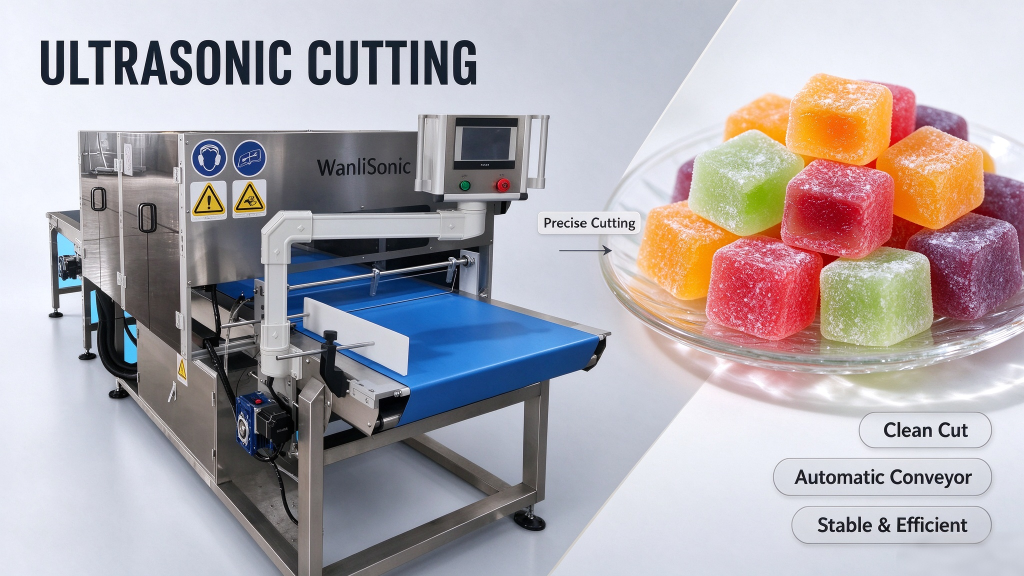
Ultrasonic cutting systems can be integrated into automated production processes, depending on the machine configuration. Options may include controlled cutting movements, conveyor feeding, and customized cutting arrangements.
These features can help reduce repetitive manual operations and improve production workflow. Actual throughput depends on product dimensions, cutting patterns, loading methods, and the number of cutting operations required.
Before purchasing equipment, manufacturers should confirm the required output and test whether the proposed machine can meet their production targets.
What Types of Candy Can Be Cut with Wanlisonic Ultrasonic Technology?
Different confectionery products have different textures and cutting requirements. Ultrasonic cutting may be suitable for a range of products, subject to testing and machine configuration.
Potential applications include:
- Soft and chewy candy: Products that may deform or stick during conventional cutting.
- Nougat and nut-filled confectionery: Products containing nuts or other inclusions that require careful cutting.
- Jelly and gummy products: Certain soft or elastic confectionery products that require controlled portioning.
- Caramel-based candy: Sticky products for which blade adhesion and temperature control are important considerations.
- Layered confectionery: Products with different textures or fillings that require clean, well-defined cutting surfaces.
Not every candy formulation is suitable for the same ultrasonic cutting setup. Hardness, elasticity, sugar content, inclusions, product temperature, and thickness all affect cutting performance.
Wanlisonic recommends evaluating representative samples to determine the most appropriate blade configuration, cutting method, and operating parameters.
How Can an Ultrasonic Candy Cutting Machine Fit into a Production Line?
A suitable candy-cutting solution should match the manufacturer’s complete production process rather than focus only on the cutting operation.
Depending on the application, the process may involve product feeding, positioning, portioning, cutting, and transfer to the packaging stage. Automated feeding and conveyor systems can help coordinate these operations and reduce unnecessary manual handling.
For manufacturers with specific requirements, customized equipment arrangements may be considered according to product dimensions, desired piece sizes, production capacity, and available factory space.
Before confirming a machine design, it is helpful to prepare the following information:
- Candy type and ingredient characteristics.
- Original product dimensions and shape.
- Required finished-piece dimensions.
- Expected production capacity.
- Preferred cutting pattern and packaging method.
- Available production-line space and automation requirements.
With these details, the equipment supplier can better evaluate the application and recommend a practical cutting solution.
Why Consider Wanlisonic for Candy Cutting?
Wanlisonic provides ultrasonic food-cutting solutions designed around different product characteristics and production requirements.
For confectionery manufacturers, the main objective is to identify a cutting method that balances product appearance, cutting consistency, operational efficiency, and ease of maintenance.
Wanlisonic can evaluate customer requirements and discuss suitable machine configurations, including cutting methods and potential automation options. Product testing is an important step in verifying whether ultrasonic technology can deliver the desired results for a particular candy formulation.
To learn more about the application, watch the Wanlisonic ultrasonic candy cutting video:
If you are planning to upgrade your confectionery production process, sharing product samples, dimensions, and target output can help determine whether an ultrasonic candy cutting machine is appropriate for your factory.
FAQ-ultrasonic candy cutting machine
Q1: What is the main advantage of an ultrasonic candy cutting machine?
Its main advantage is that high-frequency blade vibration can reduce cutting resistance and help produce cleaner cuts, particularly for certain soft or sticky confectionery products.
Q2: Can an ultrasonic machine cut sticky candy?
It can be suitable for some sticky candy products. However, performance depends on the formulation, temperature, and texture. Product testing is recommended to confirm cutting quality and blade-cleaning requirements.
Q3: Can the machine cut nougat and caramel candy?
Ultrasonic cutting may be suitable for nougat, caramel, and other confectionery products. The appropriate configuration depends on product hardness, stickiness, inclusions, and dimensions.
Q4: Can the candy cutting machine be customized?
Customization may be possible depending on the application. Requirements such as product size, cutting pattern, target capacity, and conveyor integration should be discussed with Wanlisonic before confirming the machine design.
Q5: How can I determine whether ultrasonic cutting is suitable for my candy?
Provide the product type, dimensions, texture, required finished-piece size, and expected output. Where possible, arrange a sample test to evaluate cutting quality and production performance.
Q6: How can I request a quotation from Wanlisonic?
Contact Wanlisonic with your candy specifications, production requirements, and automation preferences. This information will help the team assess your application and recommend a suitable solution.
Contact Information:
Lucy Zheng (Senior Account Manager)
📧 Email: sales4@wanlisonic.com
📞 Phone/WhatsApp/WeChat: +86 15715037520