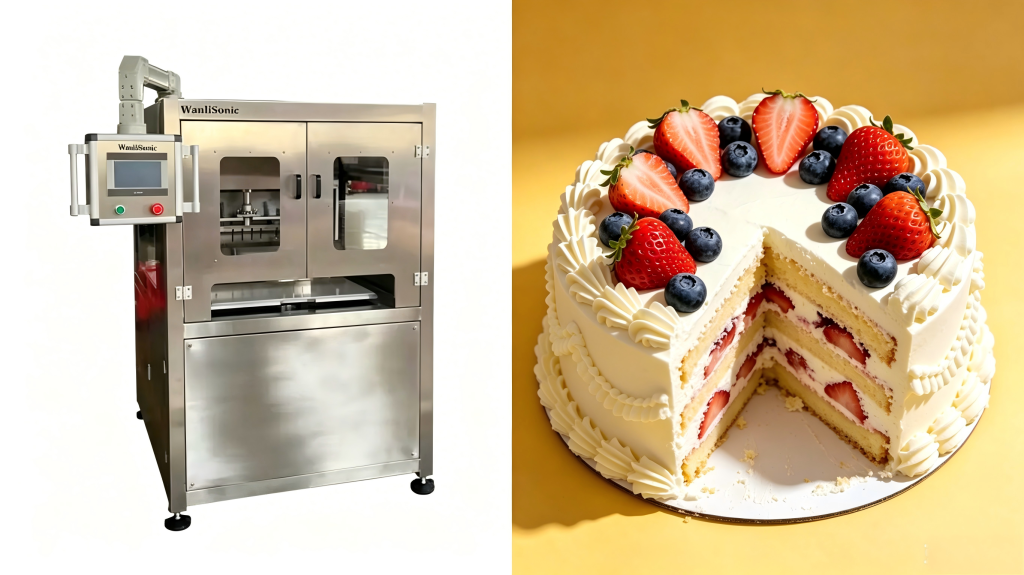
Round cakes create a different portioning challenge from rectangular slabs. Every wedge depends on the location of the cake centre, the cutting angle and the stability of the product during repeated radial cuts. A small positioning error can produce narrow tips, unequal outer edges and portions that no longer fit the intended packaging plan. The Wanlisonic Ultrasonic Round Cake Cutting Machine helps bakeries control this geometry while reducing pressure on delicate sponge, cream and layered structures.
A 45-second demonstration of the Wanlisonic Ultrasonic Round Cake Cutting Machine was published on YouTube on June 8, 2026. The public video information identifies the application but does not disclose the machine model, speed, accuracy, frequency or capacity. Those values are therefore not assigned to the demonstrated equipment in this article.
Why Is Radial Cake Portioning Difficult to Control?
A round cake must be divided around a common centre. If the product is off-centre, the blade path is misaligned or the cake shifts between cuts, the error appears across several portions rather than only one slice.
Traditional manual cutting can create:
- Wedges with unequal angles
- Narrow or blunt portion tips
- Different crust lengths around the circumference
- Compression of soft sponge and mousse layers
- Frosting dragged across the cut face
- Inconsistent portions for boxes or trays
Decoration adds another variable. Cream rosettes, fruit toppings, chocolate pieces and uneven borders may hide the true centre or make the cake harder to support. A reliable process must therefore control both cake geometry and cake texture.
How Does Ultrasonic Cutting Support Cleaner Radial Cuts?
Ultrasonic cutting applies high-frequency mechanical vibration to the blade. The vibration reduces friction between the blade and the food, allowing it to pass through suitable cake structures with less mechanical pressure than a stationary knife.
For round cakes, reduced cutting resistance can support:
- Less compression at the centre point
- Cleaner wedge tips
- Reduced cream and filling adhesion
- Fewer crumbs on exposed faces
- Better preservation of layered structures
- More consistent portion presentation
Ultrasonic technology improves the separation process, but it does not correct an off-centre cake by itself. Positioning, product support, temperature and the programmed cutting pattern must work together.
Centre Registration Is the Foundation of Equal Wedges
The centre of the cake defines every radial cut. If the detected or selected centre is displaced, each blade path divides the cake differently. The result may still look acceptable from above, but portion weight and outer-edge length can vary.
A controlled setup should consider:
- Actual cake diameter, not only the nominal mould size
- Whether the cake remains circular after cooling or decorating
- Position of the cake on the support surface
- Height and stability of toppings
- Required number and style of portions
- Acceptable visual and dimensional variation
For decorated cakes, operators may need a documented positioning method rather than relying on visible frosting patterns. Representative samples help Wanlisonic evaluate how the product should be located and supported before cutting begins.
Cutting Modes Connect Geometry with the Sales Format
The verified Wanlisonic Round Cake Ultrasonic Cutting Equipment page states that the operator can select different cutting modes through a touchscreen. It also lists circle, slice and triangle formats among the available applications. The exact functions of the video machine must still be confirmed before purchase.
For a bakery, the selected pattern should match the commercial format:
- Equal wedges: for individual slices and whole-cake portion packs
- Larger sectors: for catering or premium plated desserts
- Smaller wedges: for tasting portions or multipacks
- Alternative programmed formats: where the verified machine configuration supports them
A cutting plan should specify more than the number of pieces. It should also define cake diameter, decoration clearance, target package, presentation standard and weight-control method.
First-Piece Inspection Prevents Repeated Geometry Errors
Because a centre error affects multiple wedges, first-piece approval is especially important for round cakes. The initial cut sequence should be checked before the full batch is released.
A practical inspection can review:
- Cake centring: Is the product aligned with the selected pattern?
- Wedge geometry: Do the tips meet the required visual standard?
- Cut-face quality: Are layers visible without excessive smearing?
- Product stability: Did the cake shift during repeated cuts?
- Package fit: Do the portions enter the tray or box correctly?
- Weight distribution: Does the factory’s weighing process confirm acceptable portions?
Cutting geometry alone cannot guarantee identical weight because decorations, fillings and ingredient distribution may vary. Dimensional control should therefore work with the bakery’s established weighing and quality procedures.
Protecting Frosting, Layers and Decorative Value
Round celebration cakes and premium desserts are often sold through visual impact. A damaged centre, compressed sponge or frosting smear can reduce the value already created during baking, filling and decoration.
The Wanlisonic Ultrasonic Round Cake Cutting Machine reduces blade drag and excessive force at the cutting point. This can help maintain cleaner layers and defined wedge edges across products such as suitable sponge cakes, cream cakes, cheesecakes, mousse cakes and layered desserts. Each recipe still requires testing because temperature, density, coatings and decorations change cutting behaviour.
Topping placement should also be considered during product design. If decorations cross planned cut paths, even a clean blade may divide fruit or chocolate pieces in an undesirable way. Coordination between decorating and portioning can improve the final retail presentation.
From Clean Wedges to Packaging-Ready Portions
A wedge is production-ready only when it can be transferred without losing its shape. Very soft fillings, tall layers or unstable decorations may require suitable support after cutting. Portion dimensions must also fit the selected tray, divider or individual wrapper.
Manufacturers should connect the cutting standard with:
- Tray cavity or box dimensions
- Desired slice orientation
- Transfer and lifting method
- Decoration position
- Permitted crumbs or filling smear
- Rejection and rework criteria
This approach measures cutting performance through saleable, packable portions rather than through blade movement alone.
Evaluating Commercial Value Beyond Cutting Speed
The business value of a round cake cutter should be assessed through total process stability. Relevant measures include saleable yield, manual marking time, portion variation, cleaning interruptions, first-piece approval time and packaging correction.
A well-configured Wanlisonic Ultrasonic Round Cake Cutting Machine can help reduce repetitive manual measurement while protecting cake structure and presentation. Before recommending a solution, Wanlisonic should review actual cake samples, diameters, heights, recipes, temperatures, decorations, cutting patterns, production demand and factory layout.
The strongest result comes from treating centring, cutting and packaging as one controlled process. When the radial pattern matches the product and package, every wedge can contribute more reliably to brand consistency and manufacturing value.
Contact Wanlisonic
- Email: sales3@wanlisonic.com
- Tel / WhatsApp / WeChat: +86 15880521772
Send your cake samples, diameters, heights, temperatures, decoration layouts, required cutting patterns and packaging information to Wanlisonic for an application-based recommendation.
FAQ
1. What is an ultrasonic round cake cutting machine?
It uses a high-frequency vibrating blade to divide round cakes with reduced friction and mechanical pressure compared with a stationary knife.
2. Why is centre positioning important for round cakes?
Every wedge is created around the centre. If the cake is off-centre, the programmed radial cuts can produce unequal angles, tips and outer-edge lengths.
3. Can the machine produce different cake portion patterns?
Wanlisonic’s verified product page describes touchscreen-selectable cutting modes and lists circle, slice and triangle applications. Available patterns must be confirmed for the selected configuration.
4. Can it cut decorated or layered round cakes?
Suitable decorated, cream-filled and layered cakes can be evaluated. Wanlisonic should test the actual product because height, temperature, toppings and filling stability affect the result.
5. Does equal wedge geometry guarantee equal weight?
No. Decorations, fillings and ingredient distribution can change portion weight. Dimensional control should be combined with the bakery’s weighing and quality procedures.
6. What information is required for machine evaluation?
Provide cake diameter and height, recipe, cutting temperature, decoration layout, desired pattern, portion count, production requirement, packaging format and factory layout. Physical samples are recommended.