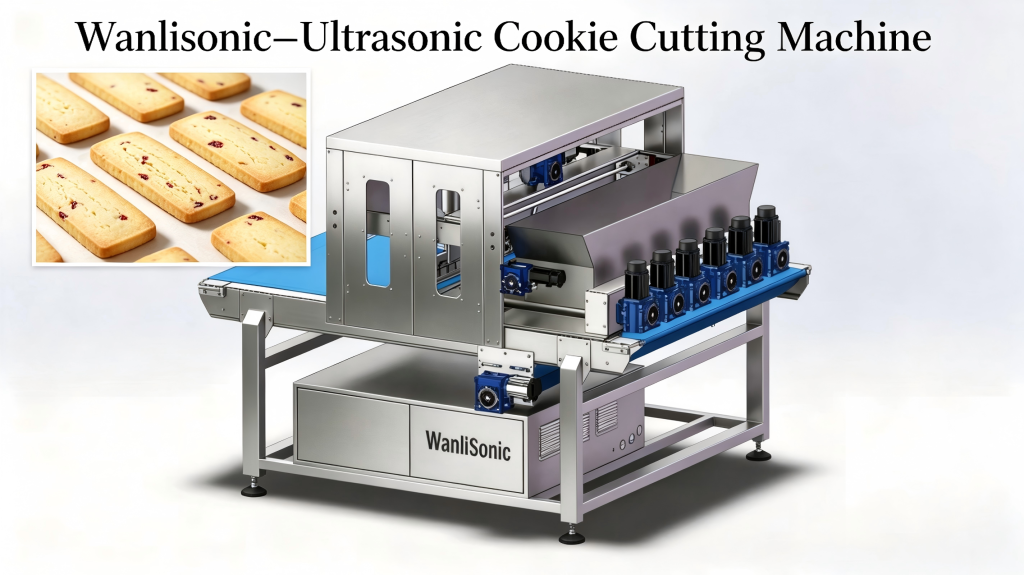
Ultrasonic cookie cutter,Cookie dough, however, is one of the most difficult materials to cut at industrial speed: it is soft, sticky and easily deformed by mechanical force. The Wanlisonic Ultrasonic Cookie Cutting Machine — an automatic tray extrusion and ultrasonic cutting machine for cookies — addresses this challenge with high-frequency ultrasonic vibration, precision titanium-alloy blades and automatic tray arrangement, delivering the clean, consistent cutting that traditional rotary or wire cutters cannot match.
The Challenge of Traditional Cookie Cutting
Conventional cookie cutting relies on mechanical force — rotary dies, stamping heads or wire cutters — which works for simple products but struggles with modern, high-value recipes:
- Soft or chilled dough sticks to metal blades, causing torn edges and misshapen pieces
- Mechanical pressure deforms delicate dough and crushes inclusions such as chocolate chips or nuts
- Sticky residue builds up on blades, forcing frequent stops for cleaning
- Cut cookies must be transferred and arranged onto baking trays by hand, a labor-intensive bottleneck
- Portion sizes drift between batches, breaking product consistency and customer expectations
These problems quietly eat into yield, labor cost and brand reputation — precisely the areas where ultrasonic technology changes the economics of cookie production.
How Does Ultrasonic Technology Improve Cookie Cutting?
The principle behind the machine is elegant. An ultrasonic transducer converts electrical energy into high-frequency mechanical vibration — in this machine, at 20,000 Hz. The cutting blade vibrates at ultrasonic frequency as it moves through the dough, so instead of pressing and tearing the product, the blade separates it with minimal resistance and friction.
The practical results are what matter to a production manager:
- Clean, smooth cut surfaces with no tearing
- No sticking — dough releases from the blade instantly
- No deformation of soft or delicate dough
- Minimal crumbs and scrap
- Consistent portion sizes from the first piece to the last
- Adjustable cutting speed of up to 60 cuts per minute
Because the blade never relies on brute force, the product keeps its intended shape and texture — a decisive advantage for premium cookie lines.
Precision Cutting for Professional Presentation
Appearance sells cookies. Uniform thickness, stable angles and consistent dimensions are what make a retail pack look professional — and what makes a private-label buyer approve a supplier. The Wanlisonic ultrasonic cookie cutter produces identical pieces across the entire run, batch after batch. The standard configuration carries two titanium-alloy blades (optional configurations are available), giving manufacturers the flexibility to match cutting geometry to product recipes while holding tight tolerances that hand or mechanical cutting cannot repeat reliably.
High-Efficiency Automation for Continuous Production
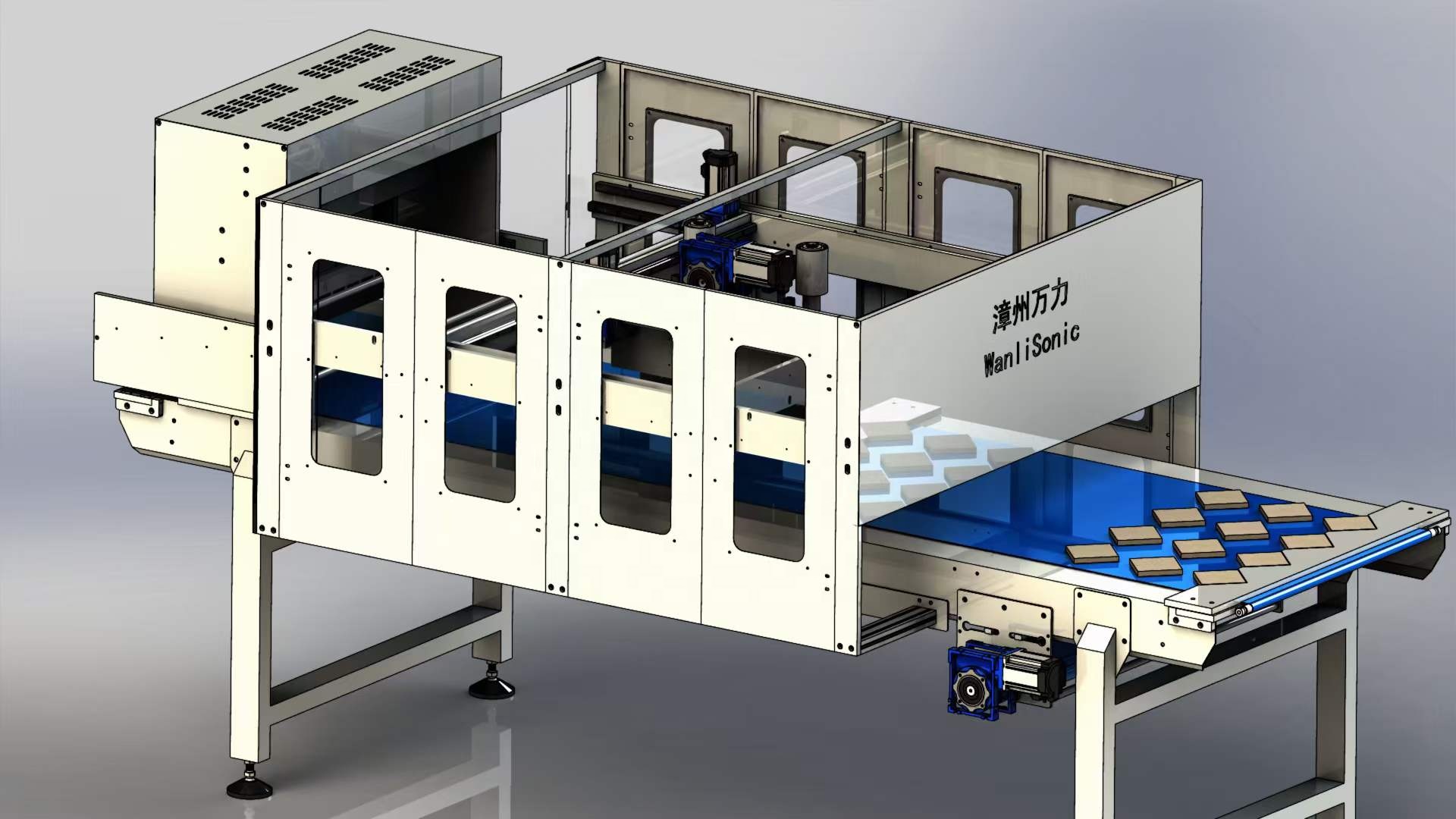
The machine, model Wanlisp2-250K800L3500, is engineered as a compact continuous-flow system (L3680 × 1135 × 1640 mm, net weight 300 kg). Its automatic tray arrangement function is the standout feature for labor savings: cut cookies are placed onto the baking tray automatically, eliminating manual arrangement. The production flow runs seamlessly:
- Dough is fed and extruded into a continuous sheet or strip
- The ultrasonic blade cuts cookies at up to 60 cuts per minute (adjustable)
- Cut pieces are automatically arranged onto the baking tray
- Filled trays advance for baking or freezing
- The cycle repeats with minimal operator intervention
One operator can supervise the line instead of a team standing at cutting and tray-filling stations — automation that directly improves throughput per labor hour.
Clean Cutting Without Damaging Delicate Dough
Modern cookie portfolios are full of fragile textures: soft-baked centers, sandwiched cream, oat and seed clusters, chocolate chunks. A traditional blade crushes these structures at the cut line; the ultrasonic blade does not. High-frequency vibration separates the dough along the blade path with virtually no compression, preserving fillings, inclusions and surface finish. For soft-baked, gluten-free and low-sugar recipes — formulations that are notoriously sticky and fragile — this gentle cutting action is often the difference between a saleable product and a scrap bin full of crumbs.
Suitable for a Wide Range of Cookie Products
One machine replaces several manual stations across a broad product range, including:
- Shortbread, butter cookies and sandwich cookies
- Chocolate chip, oat and seed-based cookies
- Digestive biscuits and hard-dough crackers
- Soft-baked and filled cookie lines
- Gluten-free and specialty dietary dough
- Frozen cookie dough for bake-at-home programs
Cutting parameters are programmable, so switching between products and shapes is fast and repeatable — a practical advantage for bakeries running multiple SKUs on the same line.
Hygienic Operation and Reduced Maintenance
Hygiene is a non-negotiable requirement in food production, and the ultrasonic cutting system is designed around it. Because the blade does not carry sticky residue, it is far less prone to harboring bacteria than conventional knives that require constant disinfection — an important safeguard for easy-moldy dough where the cut surface must not become an infection point. Combined with stainless-steel construction and compliance with FDA, CE and HACCP standards, the machine simplifies cleaning schedules and supports food-safety audits.
Reducing Waste and Increasing Manufacturing Profitability
Waste is the quietest cost in a bakery. Ultrasonic cutting attacks it at every point:
- Fewer misshapen and torn pieces — higher yield per batch
- Less crumb and scrap at the cut station
- Lower labor cost through automatic tray arrangement
- Fewer production stops for blade cleaning
- Consistent portions reduce giveaway in packed weight
For a mid-size cookie line, the cumulative effect is a measurable improvement in gross margin within the first production cycles — the return-on-investment argument that matters most to decision-makers.
Customized Solutions for Your Production Requirements
Every bakery runs differently. Wanlisonic’s R&D team — backed by more than 20 years of ultrasonic cutting expertise — works with customers to adapt cutting shapes, piece sizes, cutting speed, blade configuration and automation level to the specific line. The company invites manufacturers to send product samples and production requirements so that a recommended cutting solution can be matched to real recipes, not generic assumptions.
Wanlisonic Leads the Future of Smart Bakery Technology
Wanlisonic’s ultrasonic food cutting machines are already trusted by more than 1,000 clients and exported to Europe, the United States, the Middle East, Southeast Asia, Oceania and beyond. With a quality-first philosophy, an in-house R&D team and a global service network, Wanlisonic continues to turn ultrasonic cutting technology into practical production advantages for the baking industry. As cookie consumption grows and labor becomes harder to find, the question is no longer whether to automate precision cutting — it is how quickly a producer can bring it online.
FAQ
1. What is an ultrasonic cookie cutting machine?
An ultrasonic cookie cutting machine uses a blade that vibrates at high frequency (20,000 Hz) to separate dough with minimal friction and pressure, producing clean cuts without sticking or deformation. See the Wanlisonic cookie cutting machine product page for full specifications.
2. Why use ultrasonic technology for cookie cutting?
Traditional blades crush, stick and tear soft dough, creating misshapen pieces, crumbs and frequent cleaning stops. Ultrasonic vibration cuts cleanly without compression, improving yield, consistency and hygiene — especially for soft-baked, filled or gluten-free recipes.
3. Can the machine cut different cookie shapes and sizes?
Yes. Cutting parameters are programmable, and blade configurations can be customized (the standard unit carries two titanium-alloy blades). Shape, size and speed are adapted to the customer’s product range.
4. Does ultrasonic cutting damage soft or delicate dough?
No. Because the blade separates dough through high-frequency vibration rather than mechanical pressure, fillings, inclusions and soft textures are preserved intact at the cut line.
5. Is the machine suitable for industrial production?
Yes. The machine runs continuously at up to 60 adjustable cuts per minute with automatic tray arrangement, integrating into existing lines for commercial bakeries, food processing plants and frozen processed food facilities.
6. Can Wanlisonic customize the machine for my bakery?
Absolutely. Wanlisonic’s R&D team customizes cutting shape, size, blade configuration, speed and automation level, and evaluates customer product samples before recommending a solution.
Contact Information:
Email: sales3@wanlisonic.com
Tel / WhatsApp / WeChat: 0086-1588-0521-772
Send your product samples or production requirements to the Wanlisonic team to receive a recommended ultrasonic cookie cutting solution.