In commercial bakery production, achieving consistent cookie size, clean cutting edges, accurate shapes, and high production efficiency is essential for maintaining product quality and controlling manufacturing costs. However, conventional cookie cutting methods can create challenges when processing soft, sticky, delicate, or inclusion-rich cookie dough.
So, what is the best way for bakeries and food manufacturers to improve cookie cutting quality while reducing product deformation and blade sticking?
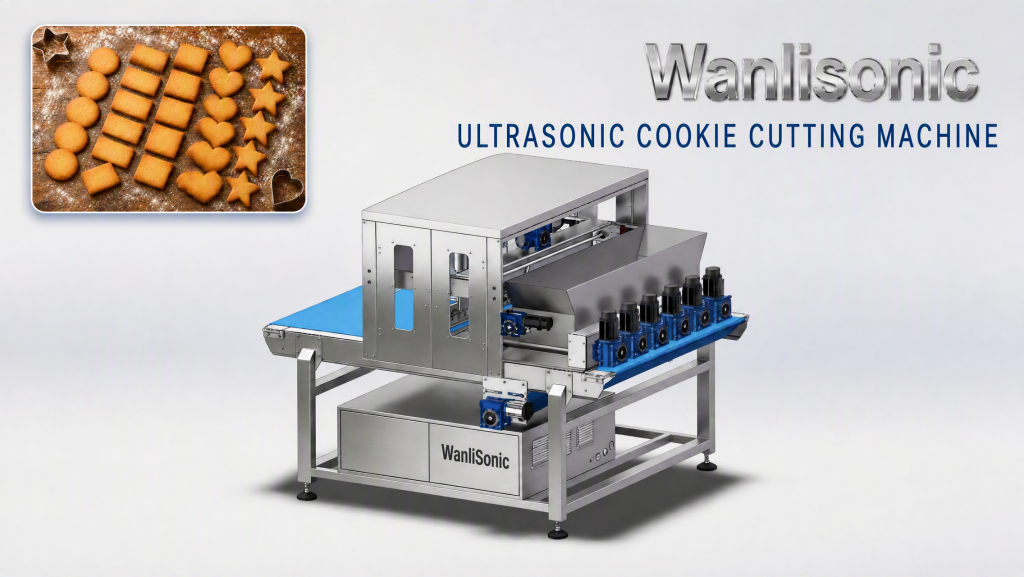
The Wanlisonic Ultrasonic Cookie Cutting Machine provides an advanced solution for manufacturers looking for cleaner, more precise, and more efficient cookie cutting technology.
Using high-frequency ultrasonic vibration, the machine reduces friction between the cutting blade and food material. This allows the blade to pass through cookie dough more smoothly, helping reduce deformation, sticking, crumbs, and irregular cutting results.
For commercial bakeries, cookie manufacturers, food factories, and specialty bakery businesses, ultrasonic cutting technology can provide a practical alternative to traditional mechanical cutting methods.
What Is an Ultrasonic Cookie Cutting Machine?
An ultrasonic cookie cutting machine is a specialized food cutting machine that uses ultrasonic vibration to assist the cutting process.
Unlike a conventional cookie cutter, which relies primarily on mechanical pressure, an ultrasonic cutter uses a vibrating blade to reduce friction during cutting. The ultrasonic system typically consists of an ultrasonic generator, transducer, booster, and specially designed food-grade cutting blade.
During operation, electrical energy is converted into high-frequency mechanical vibration. The vibration is transmitted to the cutting blade, allowing the blade to move through the cookie material with significantly reduced friction.
This technology is particularly useful for bakery products that are soft, sticky, delicate, or contain hard ingredients.
The Wanlisonic Ultrasonic Cookie Cutting Machine is designed to address these specific challenges and provide manufacturers with a more controlled cookie cutting process.
Why Are Traditional Cookie Cutting Methods Challenging?
Traditional cookie cutting systems can work well for certain products, but they may encounter difficulties when cookie dough has a high level of softness, stickiness, or inclusions.
Mechanical cutting can apply considerable pressure to the product. As a result, manufacturers may experience:
- Cookie shape deformation
- Uneven cutting edges
- Dough sticking to the blade
- Increased crumbs
- Product damage around hard inclusions
- Frequent blade cleaning
- Inconsistent cookie dimensions
- Higher material waste
- Additional manual intervention
These problems become particularly important for manufacturers producing premium cookies, customized shapes, filled cookies, or recipes containing nuts, chocolate, raisins, and dried fruits.
For a B2B bakery manufacturer, even small inconsistencies can become significant when multiplied across thousands of products.
This is why choosing the right cookie cutting machine is an important part of modern bakery production.
How Does Wanlisonic Ultrasonic Cookie Cutting Technology Work?
The key difference between ultrasonic cutting and conventional cutting is the use of high-frequency blade vibration.
When the ultrasonic system is activated, the cutting blade vibrates at high frequency. This vibration reduces the resistance and friction generated during contact between the blade and cookie material.
As the blade moves through the product, the ultrasonic vibration helps separate the material more smoothly.
For cookie manufacturers, this can provide several practical advantages:
Cleaner cutting: The blade can move through the dough with less resistance.
Reduced sticking: Less friction can help reduce dough accumulation on the blade.
Better shape retention: Lower cutting resistance can help minimize deformation.
Consistent cutting: Controlled cutting movement helps maintain product uniformity.
Improved processing of inclusions: Ultrasonic cutting can be suitable for cookie dough containing ingredients such as nuts, chocolate pieces, raisins, and dried fruits.
The exact cutting performance depends on the recipe, temperature, product dimensions, inclusions, and machine configuration. Therefore, product testing is recommended before selecting the final equipment configuration.
What Types of Cookie Dough Can Wanlisonic Ultrasonic Cutting Handle?
One of the main reasons manufacturers consider ultrasonic cutting is its ability to work with food materials that can be difficult to process using conventional blades.
The Wanlisonic ultrasonic cookie cutting solution can be applied to various cookie dough formulations, particularly products where sticking, deformation, or cutting resistance are major concerns.
Potential applications include cookie dough containing:
- Nuts
- Chocolate pieces
- Raisins
- Dried fruits
- Other particulate ingredients
The technology can also be used for cookie products with different shapes produced by extrusion or molding processes.
For example, manufacturers can produce customized cookies in shapes such as:
- Star-shaped cookies
- Flower-shaped cookies
- Round cookies
- Decorative cookies
- Customized branded shapes
This flexibility makes an ultrasonic cookie cutter attractive to manufacturers serving different retail, foodservice, and specialty bakery markets.
Can Ultrasonic Cutting Improve Cookie Shape and Appearance?
Yes. Product appearance is one of the most important considerations in commercial cookie production.
When a conventional blade presses through soft dough, the pressure can cause the dough to move, compress, or deform. This may result in cookies that do not fully match the original mold or design.
Ultrasonic cutting reduces the frictional resistance generated during the cutting process. This can help the cutting blade pass through the dough more smoothly and reduce unnecessary mechanical pressure.
For manufacturers producing premium or customized cookies, maintaining the intended shape can improve:
- Product presentation
- Packaging consistency
- Brand appearance
- Retail shelf appeal
- Customer perception
- Production consistency
This is especially valuable for manufacturers producing decorative cookies, seasonal products, gift-box cookies, and customized products for private-label customers.
How Can Wanlisonic Ultrasonic Cookie Cutter Reduce Blade Sticking?
Blade sticking is a common production problem when cutting soft or sticky bakery products.
With conventional cutting equipment, dough may adhere to the blade after repeated cutting cycles. Operators may then need to stop the machine and clean the blade, resulting in production interruptions.
Ultrasonic vibration changes the cutting conditions.
The high-frequency vibration reduces friction between the blade and the food material, helping minimize material buildup during cutting.
For manufacturers, this may contribute to:
- Reduced blade sticking
- Fewer production interruptions
- Easier routine cleaning
- More stable cutting performance
- Lower operator intervention
However, cleaning and sanitation are still essential for any food processing machine. The actual cleaning frequency should be determined according to the product formulation and factory hygiene procedures.
Why Choose Wanlisonic as Your Ultrasonic Cookie Cutting Machine Supplier?
For international bakery equipment buyers, choosing a machine manufacturer is not only about purchasing equipment. Technical support, customization capability, application experience, and communication are equally important.
Wanlisonic focuses on ultrasonic food cutting technology and provides solutions for a wide range of bakery and food processing applications.
Its ultrasonic cutting product range covers applications such as:
- Cookie cutting
- Cake cutting
- Bread cutting
- Toast slicing
- Sandwich cutting
- Swiss roll cake cutting
- Candy cutting
- Cheese cutting
- Other soft and sticky food products
For cookie manufacturers, Wanlisonic can evaluate the customer’s product characteristics and recommend an appropriate ultrasonic cutting configuration.
Instead of using a one-size-fits-all approach, the cutting solution can be considered according to factors such as:
- Cookie size
- Cookie thickness
- Dough formulation
- Product temperature
- Hard ingredients
- Required cutting shape
- Production capacity
- Automation requirements
- Factory layout
This approach is particularly important for B2B buyers because the correct ultrasonic configuration depends heavily on the actual food product.
Is Wanlisonic Ultrasonic Cookie Cutting Machine Suitable for Bakery Factories?
The answer depends on the customer’s production requirements, but ultrasonic cookie cutting technology can be used across different bakery production environments.
Potential users include:
Industrial Cookie Manufacturers
Large cookie manufacturers can use automated cutting technology to achieve more consistent product quality and reduce manual processing.
Commercial Bakeries
Medium-sized bakeries can benefit from improved cutting consistency and reduced blade sticking when producing a wide variety of cookie products.
Specialty Cookie Producers
Manufacturers producing premium, decorative, seasonal, or customized cookies can benefit from improved shape preservation.
Private-Label Food Manufacturers
For contract manufacturers producing different cookie designs for multiple brands, flexible cutting technology can support product diversification.
Standalone Machine or Production Line Integration?
Different customers have different levels of automation.
Some bakeries require an independent ultrasonic cookie cutting machine for a specific production process, while larger food manufacturers may require an ultrasonic cutting system integrated into an automated production line.
Wanlisonic provides ultrasonic food cutting solutions that can be configured according to the customer’s production requirements.
For an automated project, the ultrasonic cutting system may be designed to work together with upstream and downstream equipment, depending on the product and factory layout.
Before purchasing, manufacturers should provide information about their existing production process, product dimensions, desired capacity, and automation requirements. This allows the equipment supplier to determine the most appropriate solution.
What Are the Main Benefits of Wanlisonic Ultrasonic Cookie Cutting Machine?
For B2B bakery manufacturers, the most important benefits can be summarized as follows:
1. Cleaner Cutting
Ultrasonic vibration helps the blade move through cookie dough with lower friction, supporting cleaner cutting results.
2. Reduced Product Deformation
Lower cutting resistance can help maintain the intended cookie shape.
3. Less Blade Sticking
The ultrasonic cutting process can reduce dough accumulation on the blade.
4. Consistent Product Quality
Controlled cutting helps manufacturers achieve more uniform cookie dimensions and appearance.
5. Suitable for Different Shapes
Ultrasonic cutting can be applied to cookies produced in various customized shapes.
6. Suitable for Products with Inclusions
Cookie dough containing nuts, chocolate, raisins, and dried fruit can be considered for ultrasonic cutting applications.
7. Improved Production Efficiency
Reduced sticking and more stable cutting can help minimize unnecessary production interruptions.
8. Flexible Application
The technology can be evaluated for different bakery recipes, product dimensions, and production requirements.
What Should You Consider Before Buying an Ultrasonic Cookie Cutting Machine?
Choosing the right ultrasonic cookie cutter machine requires more than simply comparing machine prices.
B2B buyers should provide the supplier with detailed product information, including:
Product dimensions: Length, width, thickness, and overall cookie size.
Product formulation: Information about dough characteristics and inclusions.
Product temperature: Chilled, room temperature, frozen, or other conditions.
Cookie shape: Standard or customized shape.
Required capacity: Target pieces per minute or production output.
Cutting requirements: Straight cutting, portioning, cross cutting, or customized cutting.
Automation level: Standalone operation or production-line integration.
Factory conditions: Available power supply, floor space, and production layout.
Providing this information allows Wanlisonic’s technical team to evaluate the application and recommend a suitable configuration.
Why Is Ultrasonic Technology Becoming Important in Modern Bakery Production?
The bakery industry is moving toward greater automation, higher product consistency, and more diversified product designs.
At the same time, consumers are demanding more premium and visually attractive bakery products.
This creates a challenge for manufacturers: how can they increase production efficiency while maintaining the quality and appearance of every product?
Ultrasonic cutting technology offers one possible solution.
By reducing friction and cutting resistance, ultrasonic blades can provide advantages that are difficult to achieve with conventional mechanical cutting alone.
For cookie manufacturers, this means greater flexibility when working with soft dough, sticky materials, customized shapes, and recipes containing inclusions.
As a result, the Wanlisonic Ultrasonic Cookie Cutting Machine can be considered not only as a cookie cutter, but as part of a broader strategy for improving bakery production quality and efficiency.
Conclusion: Is Wanlisonic Ultrasonic Cookie Cutting Machine the Right Solution for Your Bakery?
For manufacturers looking for a reliable cookie cutting machine supplier, ultrasonic technology is worth considering when conventional cutting creates problems such as sticking, deformation, rough edges, or inconsistent shapes.
The Wanlisonic Ultrasonic Cookie Cutting Machine uses high-frequency ultrasonic vibration to assist the cutting process, helping manufacturers achieve cleaner cuts, reduced friction, improved shape retention, and more consistent production.
From soft cookie dough to products containing nuts, chocolate, raisins, or dried fruits, ultrasonic cutting can provide a flexible solution for a wide range of bakery applications.
Wanlisonic supports customers with ultrasonic food cutting solutions for commercial bakeries, cookie manufacturers, food processing companies, and customized bakery projects.
If you are planning to purchase an ultrasonic cookie cutting machine, please send Wanlisonic your cookie samples, product dimensions, dough characteristics, required output, and cutting requirements. The technical team can evaluate your application and recommend a suitable machine configuration.
FAQ—About Wanlisonic Ultrasonic Cookie Cutting Machine
1. What is the Wanlisonic Ultrasonic Cookie Cutting Machine?
The Wanlisonic Ultrasonic Cookie Cutting Machine is a food processing machine that uses high-frequency ultrasonic vibration to assist in cutting cookie dough. It is designed to provide cleaner cutting and reduce friction between the blade and food material.
2. What types of cookies can an ultrasonic cookie cutting machine process?
It can be considered for different cookie products, particularly soft, sticky, or inclusion-rich dough. Applications may include cookies containing nuts, chocolate pieces, raisins, dried fruits, and similar ingredients.
3. Can Wanlisonic ultrasonic cutting reduce cookie deformation?
Yes. By reducing cutting friction and mechanical resistance, ultrasonic cutting can help minimize deformation and support better shape retention.
4. Can the machine cut customized cookie shapes?
Yes. Ultrasonic cutting solutions can be adapted to different product shapes depending on the cookie-forming and cutting process. Customized shapes such as stars, flowers, and other designs can be considered.
5. Does ultrasonic cutting prevent the blade from sticking?
Ultrasonic vibration can significantly reduce friction and help minimize material buildup on the cutting blade. However, actual performance depends on the cookie recipe and operating conditions.
6. Can the machine cut cookies containing nuts and chocolate?
Yes. Cookie dough containing ingredients such as nuts, chocolate pieces, raisins, and dried fruits can be evaluated for ultrasonic cutting.
7. Is Wanlisonic a cookie cutting machine manufacturer or supplier?
Wanlisonic specializes in ultrasonic food cutting machinery and provides equipment and customized solutions for bakery and food processing applications.
8. Can Wanlisonic provide a customized cookie cutting solution?
Yes. The machine configuration can be evaluated according to cookie dimensions, recipe characteristics, shape, required output, automation level, and factory conditions.
9. Can I test my cookie dough before purchasing the machine?
Product testing is strongly recommended for B2B equipment projects. Customers can provide cookie samples or detailed product information so Wanlisonic can evaluate cutting performance and recommend an appropriate solution.
10. How can I get a quotation for a Wanlisonic Ultrasonic Cookie Cutting Machine?
Please contact Wanlisonic with your product information, including cookie size, thickness, recipe characteristics, desired shape, production capacity, and automation requirements.
Contact Information:
Mia Wu (Senior Customer Consultant)
📧 Email: sales1@wanlisonic.com
📞 Tel / WhatsApp / WeChat: +86 15759607601