Introduction: Why Is Cutting Quality Important for Apple Bread Manufacturers?
Apple bread is a popular bakery product known for its soft texture, pleasant apple flavor, and combination of bread and fruit ingredients. Whether produced by industrial bakeries, commercial food manufacturers, or specialized bakery workshops, maintaining consistent slice sizes and an attractive appearance is essential for product quality and customer satisfaction.
However, cutting apple bread can present several challenges. Its soft bread structure, combined with fruit pieces and potentially sticky fillings, can make conventional mechanical cutting difficult. Traditional blades may compress the bread, pull apart the internal structure, or leave uneven cutting surfaces. These problems can affect the appearance of the final product, increase crumbs, and result in unnecessary product waste.
So, how can manufacturers achieve cleaner, more consistent apple bread slices while improving production efficiency?
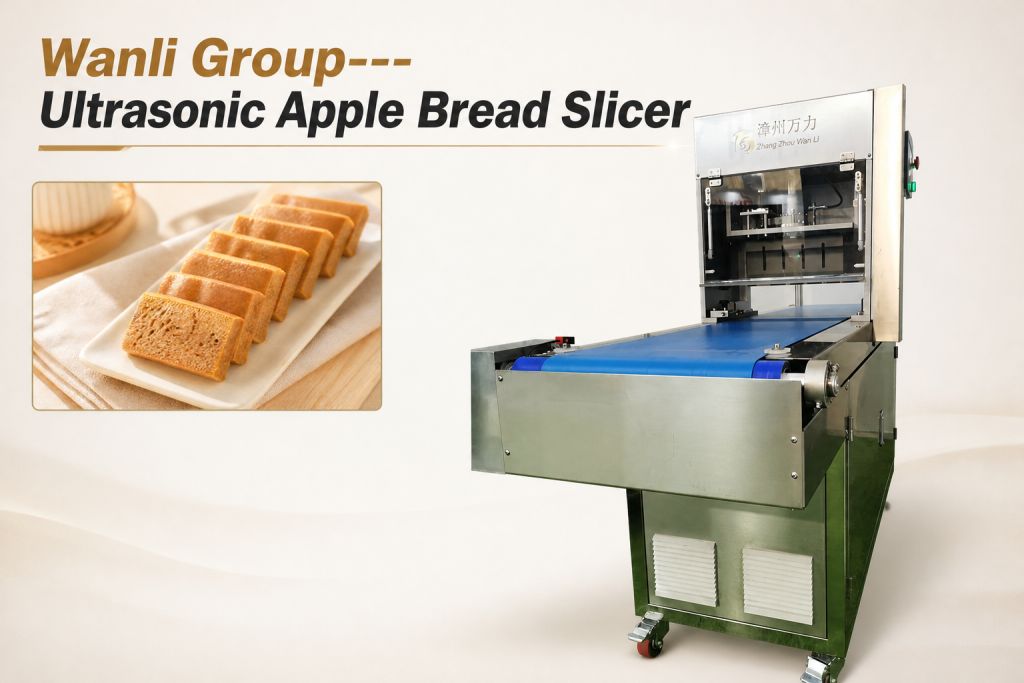
Wanlisonic Ultrasonic Apple Bread Slicer provides an advanced cutting solution by applying ultrasonic vibration technology to bakery food processing. By using a high-frequency vibrating blade, the machine helps reduce cutting resistance and delivers cleaner, smoother cuts while maintaining the original structure of soft bakery products.
1. What Makes Wanlisonic Ultrasonic Apple Bread Slicer Different?
The key difference between ultrasonic cutting and conventional mechanical cutting lies in the working principle.
Traditional cutting machines mainly rely on mechanical pressure and blade movement to separate food products. When cutting soft or sticky bakery products, the blade can push against the material, causing deformation, compression, and uneven edges.
Wanlisonic ultrasonic cutting technology works differently.
The ultrasonic generator converts electrical energy into high-frequency electrical signals. These signals are transmitted to an ultrasonic transducer, which converts the electrical energy into mechanical vibration. Through the ultrasonic booster, the vibration is transferred to the cutting blade.
The blade then vibrates at high frequency during the cutting process.
This rapid vibration reduces friction and resistance between the blade and the food material, allowing the blade to pass through the product more smoothly.
For apple bread processing, this technology offers several potential advantages:
- Cleaner cutting surfaces: Helps produce neat and attractive slices.
- Reduced product deformation: Minimizes the pressure applied to soft bread during cutting.
- Less material adhesion: Helps reduce food residue sticking to the blade.
- Improved cutting consistency: Supports uniform slice dimensions when the product positioning and cutting settings are properly configured.
- Reduced crumbs: Helps minimize unnecessary crumbs and product loss during cutting.
These advantages make ultrasonic technology a valuable option for bakeries looking to improve their cutting processes.
2. How Does the Ultrasonic Apple Bread Cutting Process Work?
The cutting process combines ultrasonic vibration technology with mechanical positioning and cutting movements.
First, apple bread is placed in the designated cutting position. The operator or production system sets the required cutting parameters according to the product dimensions and desired slice thickness.
Once the machine starts operating, the ultrasonic generator activates the cutting system. High-frequency vibration is transmitted to the blade, preparing it for the cutting operation.
The cutting blade then moves through the apple bread. Because of the ultrasonic vibration, the blade can separate the product with less resistance than a conventional non-vibrating blade.
After completing the cutting movement, the machine returns to its next operating position and continues the process according to the configured cutting program.
The cutting result depends on several factors, including:
- Apple bread dimensions and thickness.
- Bread texture and internal structure.
- Moisture content and fruit distribution.
- Required slice thickness.
- Blade configuration and cutting speed.
- Product temperature during processing.
For this reason, Wanlisonic recommends evaluating actual product samples before confirming the final machine configuration. This helps ensure that the selected ultrasonic cutting solution matches the customer’s production requirements.
3. What Are the Main Advantages of Ultrasonic Cutting for Apple Bread?
3.1 Maintaining the Original Product Shape
One of the most important requirements when cutting soft bakery products is avoiding unnecessary compression.
When a conventional blade presses against soft bread, the product may become flattened or distorted. This is particularly undesirable for packaged bakery products, where appearance directly influences consumer perception.
Ultrasonic vibration reduces cutting resistance and helps the blade move through the product more smoothly.
As a result, manufacturers can achieve better control over product deformation and improve the overall appearance of the finished slices.
3.2 Cleaner Cutting Edges
Apple bread may contain different ingredients, such as fruit pieces, fillings, or other inclusions.
These ingredients can make conventional cutting more complicated because they may stick to the blade or interfere with the cutting movement.
The ultrasonic blade’s high-frequency vibration helps reduce adhesion during cutting, contributing to cleaner cutting edges and more attractive finished products.
The actual cutting performance depends on the recipe, product condition, and machine configuration.
3.3 Reduced Blade Cleaning Requirements
Food residue accumulating on cutting blades can affect production efficiency and cutting quality.
With conventional cutting equipment, operators may need to stop production frequently to remove sticky material from the blade.
Ultrasonic vibration helps reduce material adhesion, potentially decreasing the frequency of manual blade cleaning.
For food manufacturers, this can help simplify daily operation and improve production continuity.
Regular cleaning and sanitation are still necessary to meet food hygiene requirements.
3.4 Consistent Slice Sizes
Product consistency is essential for commercial bakery production.
Different slice thicknesses can affect packaging, portion control, product presentation, and customer experience.
By configuring the cutting program according to the required dimensions, an ultrasonic cutting machine can help manufacturers achieve consistent cutting results.
For businesses producing apple bread for supermarkets, retail bakeries, foodservice companies, or wholesale distribution, consistent portion sizes can contribute to better product standardization.
3.5 Supporting Food Production Efficiency
Cutting quality is only one part of the production process. Manufacturers must also consider labor requirements, operating stability, product waste, and cleaning time.
By reducing cutting resistance and minimizing product adhesion, ultrasonic technology can help improve the efficiency of the cutting stage.
The actual production capacity depends on the product dimensions, cutting pattern, number of blades, and operating configuration.
Wanlisonic can evaluate these factors to recommend a suitable solution for different bakery production requirements.
4. Why Choose Wanlisonic for Industrial Food Cutting Equipment?
Wanlisonic, developed by Wanli Group, specializes in ultrasonic food cutting machinery and has more than 20 years of experience in the food machinery industry.
With extensive experience in ultrasonic cutting applications, Wanlisonic provides solutions for manufacturers processing various bakery products, confectionery, and other food materials.
The company focuses on developing equipment that addresses practical production challenges rather than simply providing a cutting machine.
Important considerations include:
Food-grade construction
Machine frames can be manufactured using 304 stainless steel, with food-grade materials used for product-contact components according to the machine configuration.
Advanced ultrasonic technology
The ultrasonic generator, transducer, and cutting blade work together to provide stable high-frequency vibration for food cutting applications.
Customized cutting solutions
Different bakery products have different shapes, dimensions, textures, and cutting requirements. Wanlisonic can evaluate customer samples and production needs to determine the appropriate machine configuration.
Professional technical support
From product testing and machine selection to installation guidance and after-sales service, Wanlisonic aims to support customers throughout their equipment investment.
International market experience
Wanlisonic serves food manufacturers in different countries and provides machinery solutions for various industrial food processing applications.
5. Which Other Food Products Can Benefit from Ultrasonic Cutting Technology?
Although this machine is designed for apple bread cutting applications, ultrasonic cutting technology can also be used in many other food processing industries.
Depending on the machine configuration and product characteristics, potential applications include:
- Cake products: Sponge cakes, mousse cakes, layered cakes, and other soft cakes.
- Bakery products: Swiss rolls, brownies, soft bread, and specialty bakery products.
- Confectionery: Nougat, caramel, soft candy, and other sticky sweets.
- Frozen desserts: Certain frozen cakes and dessert products, subject to temperature and material testing.
- Specialty food products: Products requiring clean cutting surfaces and consistent portion sizes.
It is important to note that one machine configuration may not be suitable for every product. Blade design, cutting height, product temperature, and cutting speed should be evaluated according to the actual application.
6. How Can You Select the Right Ultrasonic Apple Bread Slicer?
Before purchasing an industrial ultrasonic cutting machine, manufacturers should consider several important factors.
Product dimensions: What are the length, width, and height of the apple bread?
Required slice thickness: How many slices are required from each product, and what is the target thickness?
Product characteristics: Is the bread soft, sticky, moist, or filled with large fruit pieces?
Production capacity: How many products or slices need to be processed per hour?
Cutting configuration: Does the application require single-direction cutting, cross-cutting, or multiple cutting blades?
Automation requirements: Will the machine operate independently or need to integrate with an existing production line?
Providing these details allows Wanlisonic’s technical team to evaluate the application and recommend a suitable solution.
For the best evaluation, customers are encouraged to send product samples, product photographs, and dimensional drawings. Actual cutting tests can help determine the most appropriate blade configuration and operating parameters.
Conclusion: Is Ultrasonic Cutting the Right Solution for Your Apple Bread Production?
For apple bread manufacturers, achieving clean slices, maintaining product appearance, and improving production efficiency are important considerations when selecting cutting equipment.
Wanlisonic Ultrasonic Apple Bread Slicer applies high-frequency ultrasonic vibration technology to help overcome common challenges associated with cutting soft and potentially sticky bakery products.
By reducing cutting resistance, minimizing product compression, and helping prevent material adhesion, ultrasonic cutting technology offers an effective alternative to conventional mechanical cutting.
With more than 20 years of experience in ultrasonic food cutting machinery, Wanlisonic is committed to providing practical and customized cutting solutions for food manufacturers worldwide.
If you are looking for a reliable apple bread cutting solution, contact Wanlisonic to discuss your product requirements and explore the possibilities of ultrasonic cutting technology.
FAQ—Ultrasonic Apple Bread Slicer
Q1: What is an ultrasonic apple bread slicer?
An ultrasonic apple bread slicer is a food cutting machine that uses high-frequency vibrating blades to cut apple bread. The ultrasonic vibration reduces cutting resistance and helps achieve cleaner cutting surfaces.
Q2: Can ultrasonic cutting prevent soft apple bread from being compressed?
Ultrasonic cutting significantly reduces the cutting resistance compared with conventional mechanical cutting. It helps minimize product compression, although the final result depends on bread texture, product dimensions, and cutting parameters.
Q3: Does the ultrasonic blade prevent apple pieces from sticking?
Ultrasonic vibration helps reduce material adhesion to the blade. However, the result depends on the moisture content, stickiness, and composition of the apple bread.
Q4: Can Wanlisonic customize the machine according to our apple bread dimensions?
Yes. Wanlisonic can evaluate product dimensions, cutting thickness, required capacity, and production requirements to recommend a suitable machine configuration.
Q5: What information should I provide to get a quotation?
Please provide product photographs, dimensions, desired slice thickness, expected production capacity, and any special cutting requirements. Product samples are also helpful for testing.
Q6: Can the ultrasonic cutting machine process other bakery products?
Yes. Depending on the machine configuration and product characteristics, ultrasonic cutting technology can be applied to various cakes, bread products, brownies, confectionery, and other food materials.
Contact Information:
Mia Wu (Senior Customer Consultant)
📧 Email: sales1@wanlisonic.com
📞 Tel / WhatsApp / WeChat: +86 15759607601