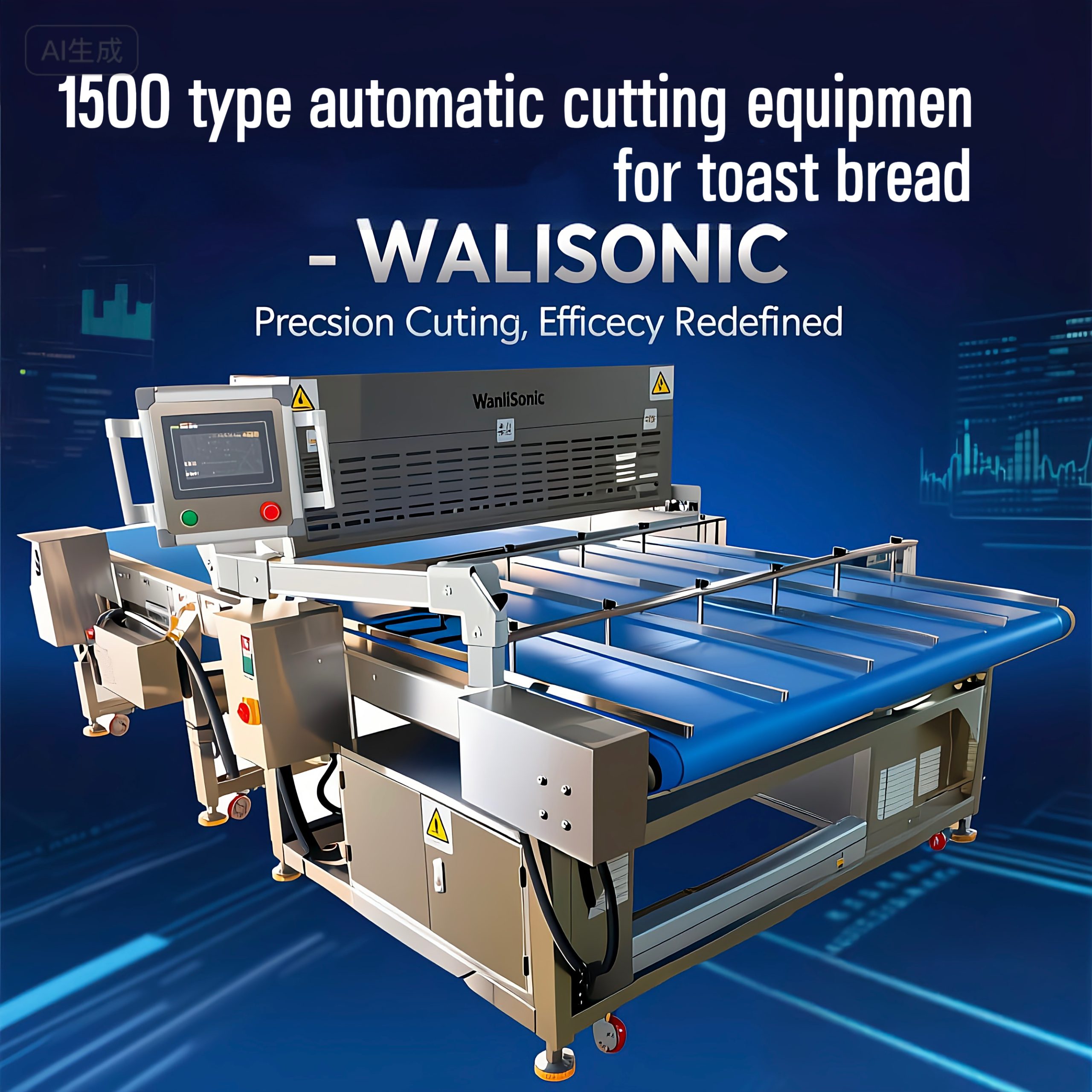
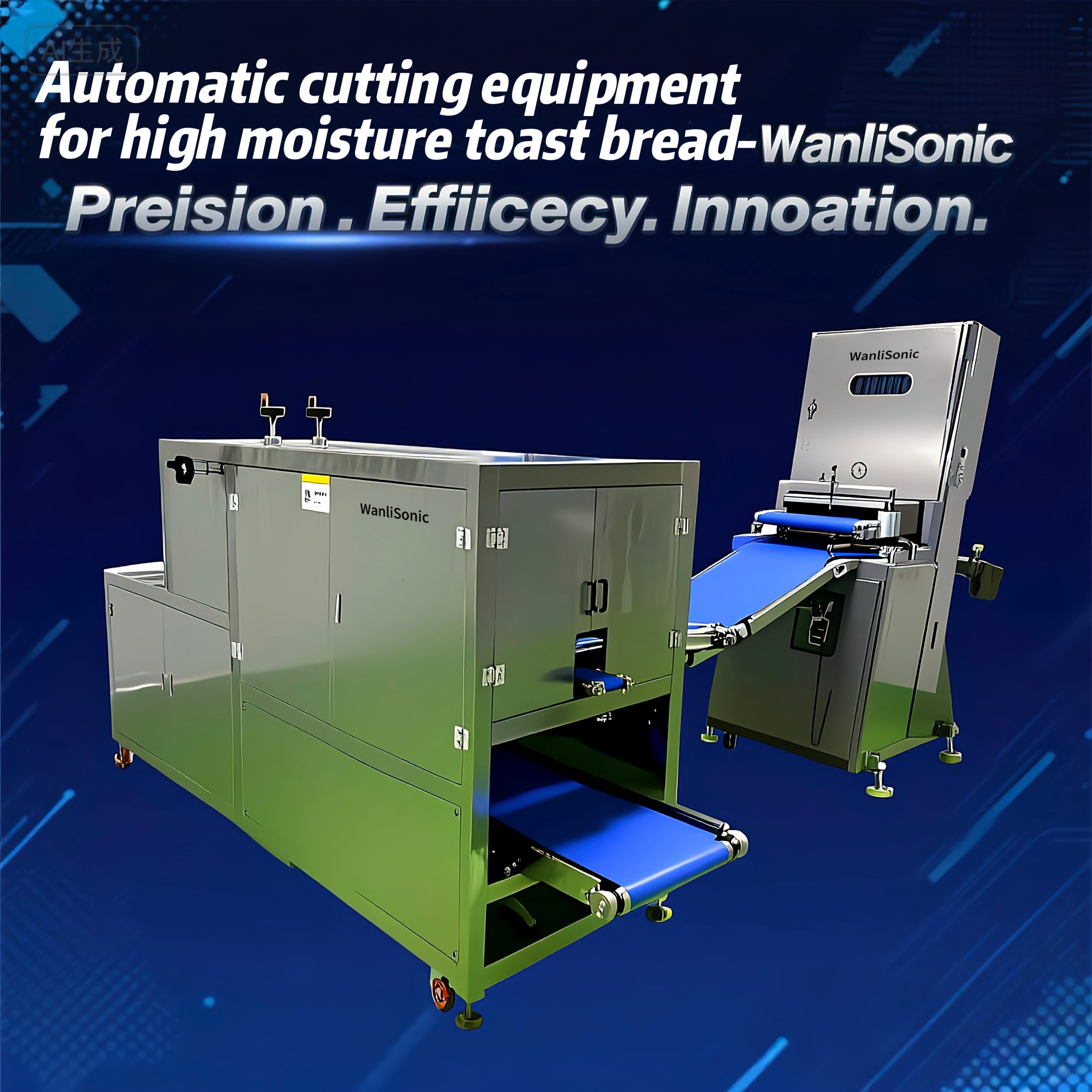
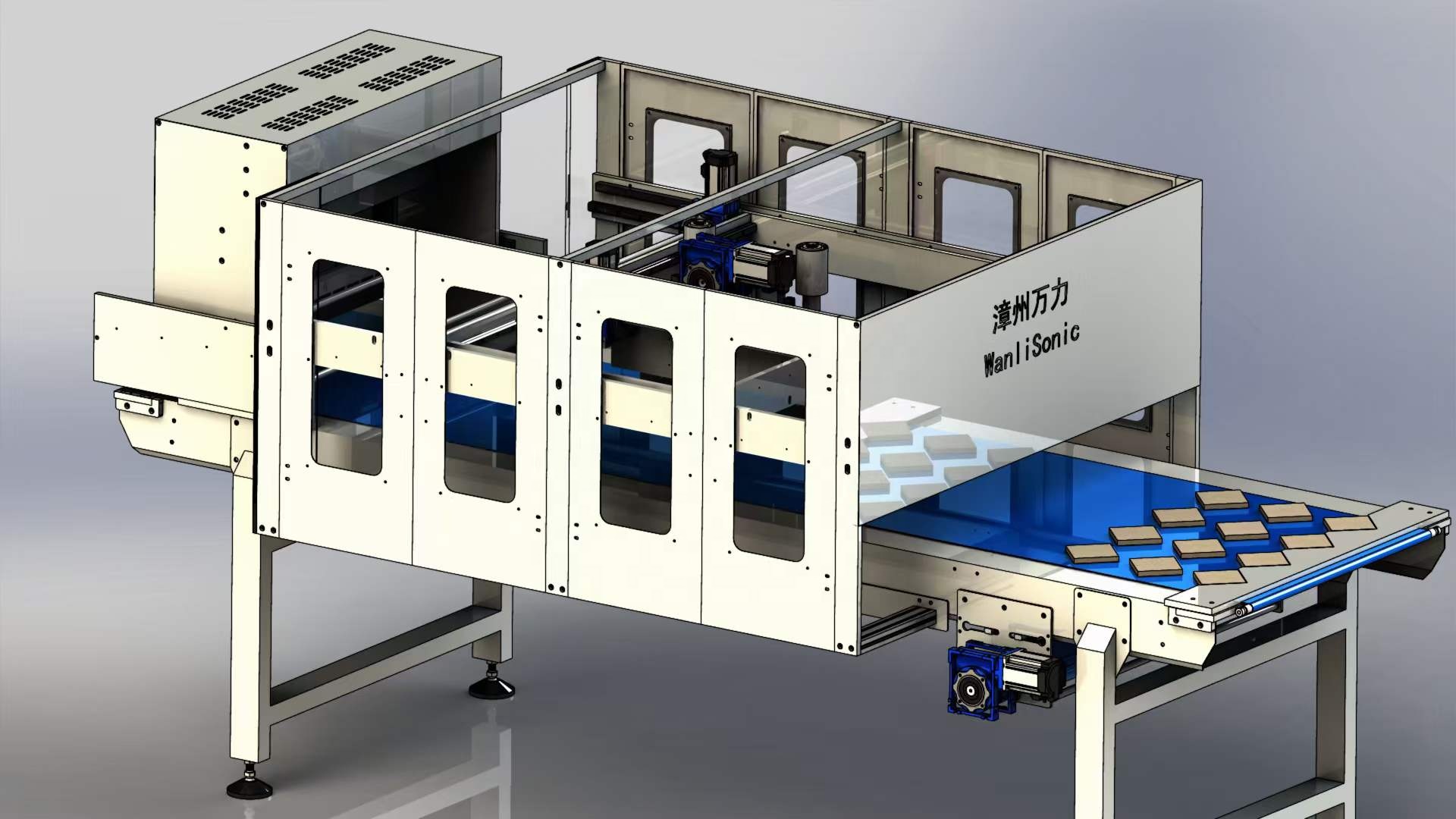
Demand for ready-to-eat sandwiches keeps rising across convenience retail, food service and travel catering, and the pressure lands squarely on the cutting stage of the production line. An assembled sandwich is far harder to process than a plain loaf: bread, sauces, cheese, ham and vegetables must be sliced together without the layers shifting, the filling being pushed out, or the sauce smearing across the cut face. The Wanlisonic Fully Automatic Slicing Sandwich Toast Production Line addresses the whole process — from bread preparation and slicing through filling, ultrasonic cutting, product transfer and packaging — as one continuous automated flow, delivering the high output and portion consistency that industrial sandwich manufacturers require.
Why Assembled Sandwich Toast Is Difficult to Cut at Industrial Speed
Sandwich production combines several soft, sticky and structurally weak materials in a single product. Conventional mechanical cutting continuously struggles with this combination:
- Multi-layer products compress and shift during the cut
- Fillings are dragged or pushed out of the sandwich body
- Sauces and cream adhere to the blade surface
- Cut faces become uneven, with smeared layers or colour transfer
- Crumbs and debris accumulate around the cutting area
- Blades require frequent cleaning, interrupting the line
- Manual labour is needed for feeding, arranging and re-working rejects
Each of these problems reduces yield and makes downstream packing harder to stabilise. In high-volume sandwich plants, they compound into a bottleneck that limits the entire line.
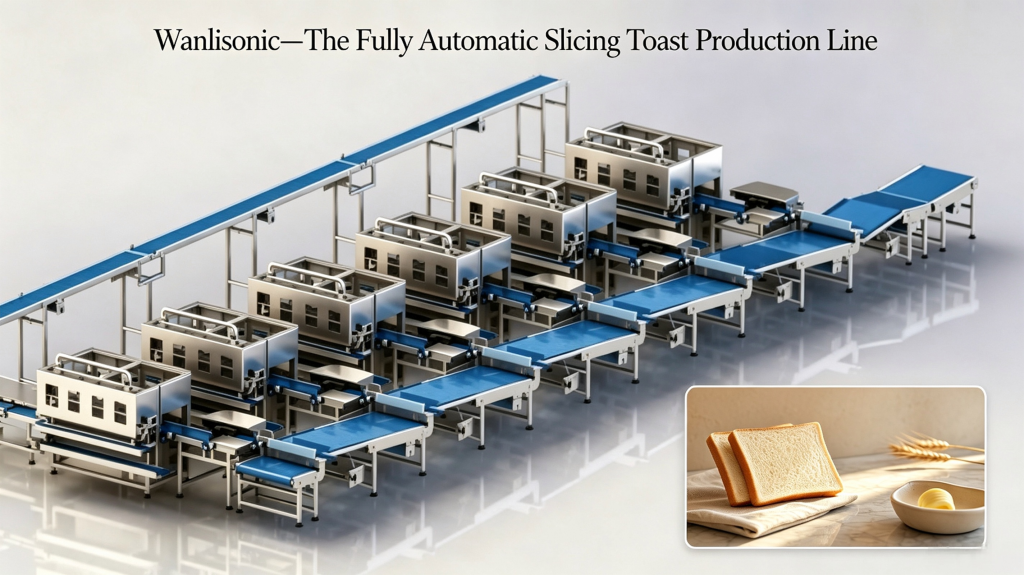
How the Fully Automatic Line Works
The value of the Wanlisonic production line is that the cutting station is not designed in isolation — it is engineered to connect with the equipment before and after it. A typical configuration runs as a continuous sequence:
- Bread preparation, including crust and skin removal where required
- Toast slicing to the required thickness for the sandwich build
- Filling and sandwich assembly with the specified layers
- Automatic feeding and positioning of the assembled sandwiches
- Ultrasonic cutting into triangles, rectangles or other formats
- Automatic product transfer to flow-pack or tray packaging
Because each stage hands over to the next without manual handling between stations, the line maintains a steady rhythm and removes the labour that normally sits between cutting and packing.
The Ultrasonic Cutting Station in Detail
The cutting centre of the line applies high-frequency vibration through a titanium alloy blade, so material is separated rather than crushed. That principle is what allows assembled sandwiches to be cut cleanly — the blade does not stick to the knife, does not smear fillings across the layers, and does not deform the product, leaving sandwich edges smooth and free from burrs and debris.
The machine is purpose-built for sandwich cutting and supports triangle and rectangular formats, with working speed and cutting angle adjustable for different products.
Precision Cutting for Professional Sandwich Presentation
For sandwiches sold through retail and convenience channels, appearance is a commercial requirement. Because ultrasonic vibration reduces friction at the cutting edge, the line produces consistent dimensions and clean cut faces batch after batch, so product quality does not depend on the individual operator. Uniform triangles and rectangles pack more predictably, present better on shelf, and reduce the rework caused by torn or displaced fillings.
Continuous High-Output Operation
The line is engineered around continuous running rather than stop-start batch processing. Key production characteristics include:
- Continuous cutting without the interruptions typical of manual or mechanical stations
- High automation with automatic tracking of the cutting process
- Low failure rate for stable uptime across long shifts
- Adjustable cutting speed and angle for different sandwich specifications
- A frequency ultrasonic scanning function that supports consistent cutting performance
This lets manufacturers scale output by extending running hours rather than adding manual cutting stations — decisive when labour availability is the real constraint on capacity.
Safety and Hygiene Built Into the Design
Sandwich lines operate under strict hygiene requirements, and the equipment reflects that. A protective security door encloses the cutting area, keeping operators clear of the blade. A flipping detection function helps prevent accidents caused by misplaced product, and a fault indicator light gives operators an immediate signal when attention is required — practical safeguards that keep a high-speed line running safely.
On the hygiene side, 304 stainless steel construction and easy-to-clean surfaces simplify daily sanitation. Because the blade does not accumulate sticky residue, cleaning intervals are less frequent than with conventional knives, which reduces downtime as well as the risk of residue building up in the cutting area. The machine holds CE certification, and Wanlisonic machines are built to align with FDA and HACCP requirements.
Toast Slicing at the Front End of the Line
Sandwich quality begins with the bread. For the slicing stage preceding assembly, Wanlisonic offers dedicated ultrasonic toast slicing equipment — for example model Wanlisp4-300K1450L2000, operating at 20,000 Hz with up to 60 adjustable cuts per minute and two optional blades. Crumbs are not only a yield loss; they contaminate downstream stations and force extra cleaning stops, so controlling them at the slicer pays back across the whole line.
Customized Integration for Your Sandwich Line
No two sandwich factories run the same layout, and Wanlisonic’s engineering team treats each project individually. It evaluates product dimensions, filling structure, product temperature, required cutting shape, capacity target, feeding method and packaging requirements before recommending a configuration, then aligns the cutting section with existing upstream preparation equipment and downstream packaging machines. Customers are encouraged to send product samples for testing before the specification is confirmed, so performance is validated on the real product rather than assumed.
More Than 20 Years in Ultrasonic Food Cutting
Wanlisonic specialises in ultrasonic food cutting equipment, with more than 20 years of manufacturing experience, an in-house R&D team and global after-sales support. Its machines are used by more than 1,000 clients and exported to Europe, the United States, the Middle East, Southeast Asia, Oceania and other markets.
Conclusion
As sandwich consumption continues to grow, the cutting stage is where quality and productivity are most easily lost. The Wanlisonic Fully Automatic Slicing Sandwich Toast Production Line combines ultrasonic cutting, automated feeding, transfer and integration with packaging into a single continuous process — delivering consistent portions, clean presentation, safer operation and less manual intervention. For manufacturers planning capacity expansion or replacing manual sandwich cutting, the new demonstration video shows exactly how the line performs.
FAQ
1. What is a fully automatic slicing sandwich toast production line?
It is an integrated production system that prepares and slices the bread, assembles the sandwich, then feeds and cuts the sandwiches with an ultrasonic blade before transferring them automatically to packaging — with minimal manual handling between stages. See the Wanlisonic sandwich cutting equipment page for details.
2. How fast is the ultrasonic sandwich cutting station?
The Wanlisonic 160K sandwich cutting machine runs at 30 to 90 cuts per minute, with working speed and angle adjustable to suit the product.
3. What sandwich formats can be produced?
Triangle and rectangular sandwiches are supported, with maximum cutting size of 12 cm × 12 cm and product height below 10 cm, customisable to customer requirements.
4. Does ultrasonic cutting damage the sandwich layers?
No. Because the blade vibrates at high frequency instead of pressing through the product, it does not stick to the knife, does not smear fillings between layers, and does not deform the bread — leaving smooth edges free from burrs and debris.
5. What safety and hygiene features are included?
The cutting area is protected by a security door, with a flipping detection function and fault indicator light to prevent accidents. The 304 stainless steel construction is easy to clean, and the machine holds CE certification while aligning with FDA and HACCP requirements.
6. Can Wanlisonic integrate the cutting line with our existing equipment?
Yes. The cutting section can be designed around your upstream preparation and downstream packaging equipment, based on factory space, sandwich dimensions, capacity targets and automation level. Wanlisonic recommends product testing before the final configuration is confirmed.
Contact Information:
Annie (Senior Customer Consultant)
Email: sales3@wanlisonic.com
Tel / WhatsApp / WeChat: 0086-1588-0521-772