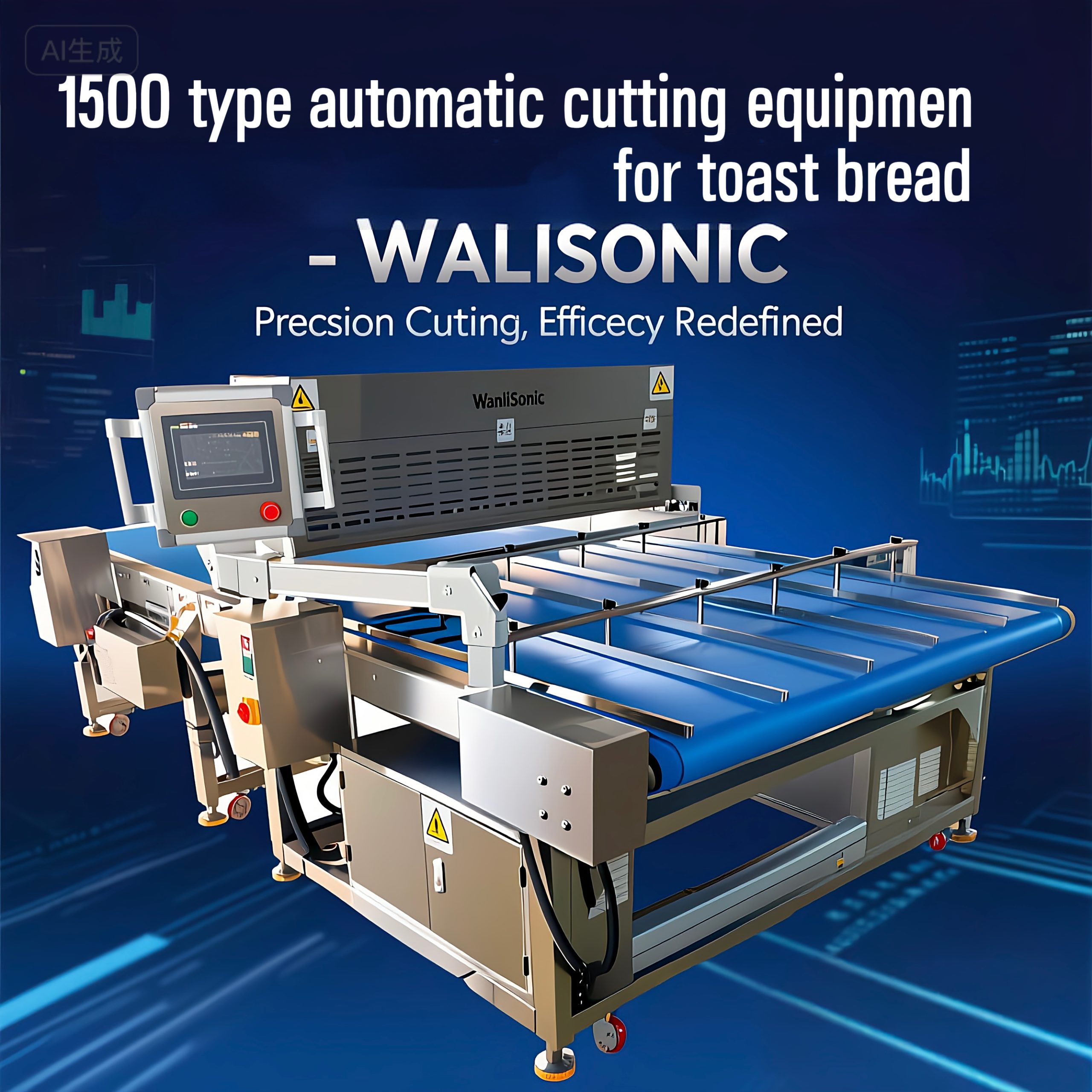
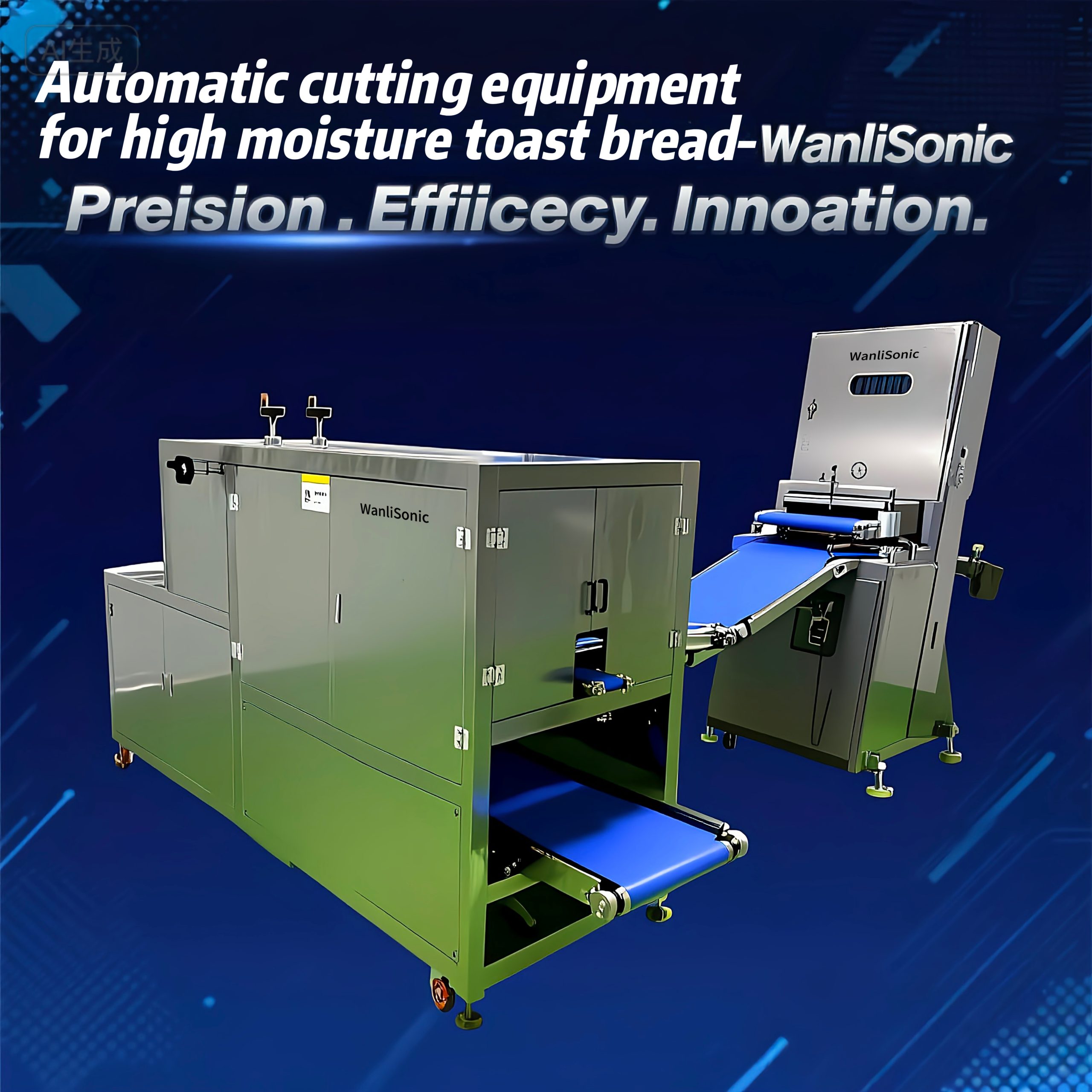
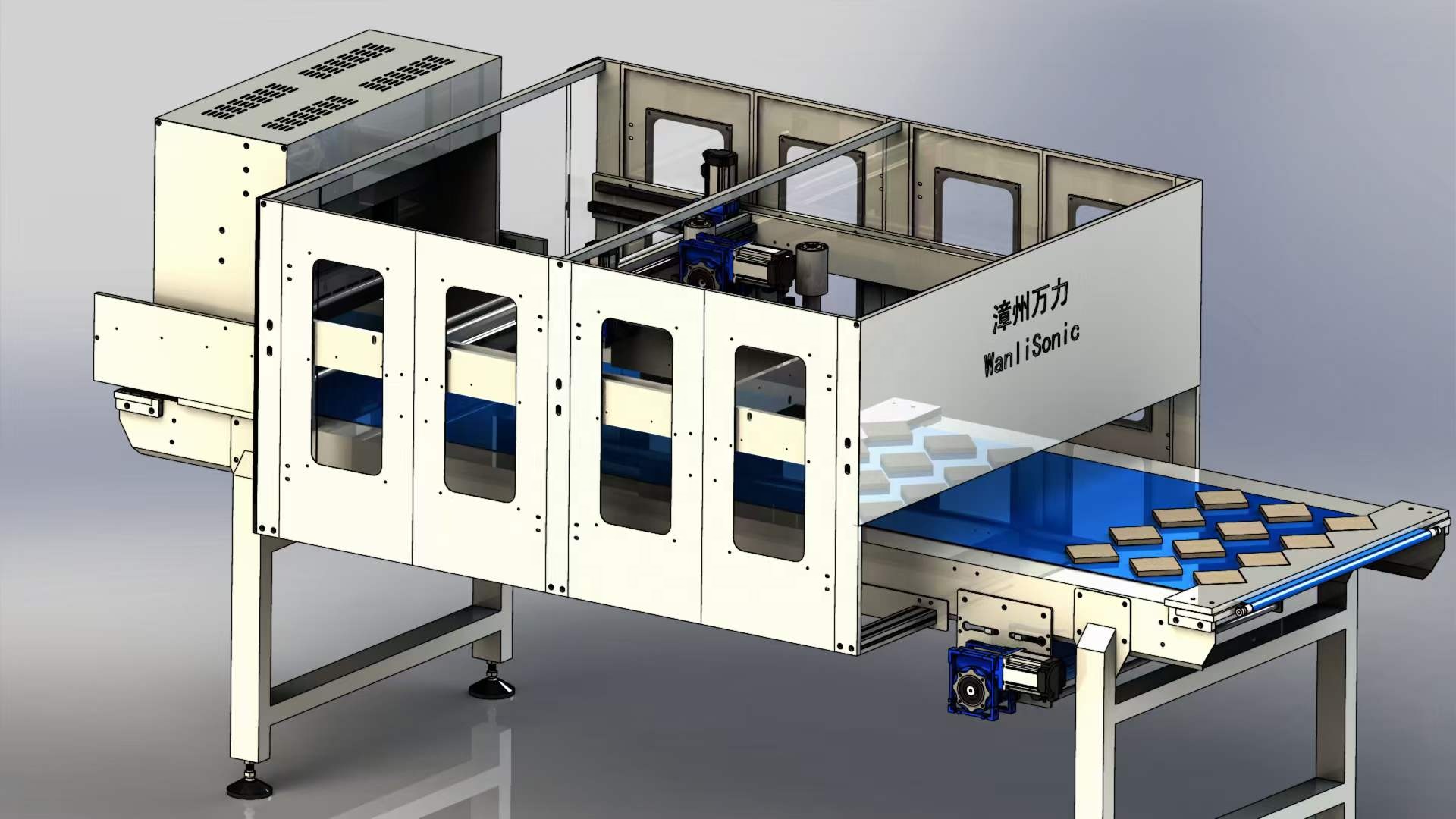
Cube cakes require coordinated cuts in more than one direction. Soft sponge, cream, jam, chocolate layers or dense brownie textures must remain stable through repeated handling. The Wanlisonic Ultrasonic Cube Cake Cutting Machine helps manufacturers produce cleaner edges, consistent geometry and portions ready for trays, cups or retail packs.
A 58-second Wanlisonic ultrasonic cube cake cutting demonstration is available on YouTube. The video confirms the cube-cake application, but its description does not identify a machine model, cutting speed, power rating or dimensional tolerance. This article therefore does not assign those values to the demonstrated equipment.
Why Is Cube Cake Cutting More Difficult Than Slicing?
A straight slicing operation divides a cake in one direction. Cube production requires a grid: the product must be separated along two axes while the portions retain equal-looking length, width and height. Any deformation during the first pass can affect the geometry created by the second pass.
Conventional cutting may cause:
- Soft sponge to compress under blade pressure
- Cream or jam to smear across multiple cut faces
- Layers to shift before the second cutting direction
- Crumbs to collect between small portions
- Sticky residue to change later cuts
- Uneven cubes that require manual sorting or trimming
As portions become smaller, minor edge damage becomes more visible. Stable product conditioning and controlled movement are therefore as important as the blade.
How Does Ultrasonic Technology Protect Cube Geometry?
Ultrasonic cutting applies high-frequency mechanical vibration to the cutting blade. The vibration reduces friction between the blade and the food, helping the tool pass through soft, sticky or layered products with less mechanical resistance than a stationary knife.
For cube cake production, reduced resistance can support:
- Cleaner vertical faces with less filling drag
- Lower compression of delicate sponge
- Better retention of layers and toppings
- Reduced product adhesion to the blade
- Fewer loose crumbs around small portions
- More repeatable geometry across the cutting grid
Results still depend on recipe, temperature, slab thickness, filling and the cutting program. Repeatable input conditions remain necessary for repeatable cubes.

Forming Cubes Through Coordinated Cutting Directions
Cube cutting is a sequence rather than a single blade movement. The cake slab must be divided into strips and then cross-cut into individual portions. Product alignment must remain stable between these operations so that the second direction completes the intended grid.
A typical automated workflow can include:
- Feeding: A cake slab or block enters the cutting area.
- Positioning: The product is aligned according to the selected cutting pattern.
- First-direction cutting: The slab is divided into parallel strips.
- Second-direction cutting: The strips are separated into cubes.
- Transfer: Finished portions move toward inspection, tray loading or packaging.
Wanlisonic’s published cube-cake product page confirms automated feeding, positioning and cutting functions. The exact movement sequence and conveyor arrangement must be confirmed for the selected configuration and the customer’s existing line.
Adjustable Portion Formats for Different Sales Channels
Small cubes may become snack bites, while larger portions suit dessert cups, catering trays or mixed assortments. Manufacturers may also need different formats for retail, food service and private-label customers.
The Wanlisonic Ultrasonic Small Cube Cake Cutting Machine product page states that cube size can be adjusted according to specific requirements. This allows manufacturers to plan portion formats around product presentation and package dimensions rather than relying on one fixed size.
Any format change should be evaluated against:
- Slab length, width and thickness
- Required cube dimensions
- Cake temperature and firmness
- Filling and topping behaviour
- Tray or package layout
- Downstream handling requirements
Because density and ingredient distribution vary, cutting should remain coordinated with weight-control procedures.
Clean Faces Improve Retail Presentation
Because cubes expose several cut faces, defects are visible from multiple angles. The Wanlisonic Ultrasonic Cube Cake Cutting Machine reduces blade drag and excessive pressure, helping preserve defined corners, visible layers and orderly presentation in transparent cups, compartment trays and dessert assortments. Well-defined portions also communicate quality before the product is tasted.
Product Temperature Is Part of the Cutting Process
Temperature changes cake behaviour: a chilled slab may hold its geometry, while a softer product may deform during transfer and over-chilled coatings may react differently at the blade.
Wanlisonic’s cube-cake product page identifies chilled and ambient-temperature cutting as supported applications. However, the correct condition must be established for the actual recipe. Manufacturers should define the product temperature, sponge moisture, filling viscosity, slab thickness and time between cooling and cutting.
A stable conditioning window reduces variation and gives the automated system a more predictable product to position and divide.
Reducing Residue and Managing Sanitation
Repeated grid cutting increases blade contact with the cake. Cream, jam and sticky toppings can accumulate and gradually affect edge quality. Wanlisonic’s product page states that an optional cleaning and disinfecting unit can be selected for the cube-cutting system.
This option may help reduce avoidable cleaning interruptions, but it does not remove the need for validated sanitation. Cleaning frequency, allergen control, inspection and changeover procedures must follow the recipe and the manufacturer’s food-safety plan. Optional equipment also needs to be confirmed in the final quotation rather than assumed to be standard.
Applications Beyond One Cake Recipe
Wanlisonic’s published cube-cutting information identifies both sweet and savoury bakery applications, including cakes, pastries, flapjacks, brownies, pies, quiches and pizzas. This versatility can improve equipment utilization for manufacturers with mixed product portfolios.
A dense brownie, soft sponge cake and layered chilled dessert behave differently, so blade movement, supports, temperature and cleaning requirements may change between recipes.
Converting Cutting Control into Business Value
A cube cake cutter should be evaluated through saleable yield, consistency, labour, cleaning, changeover flexibility and packaging readiness—not only nominal speed. By reducing compression, filling smear, crumbs and irregular geometry, the Wanlisonic Ultrasonic Cube Cake Cutting Machine protects product value. Automated positioning and adjustable formats also reduce manual measuring from slab to packaged portion.
Before recommending a solution, Wanlisonic should evaluate representative samples together with the target cube dimensions, product temperature, required output, factory layout and downstream packaging method. This application-based approach avoids treating every cake slab as the same cutting problem.
Contact Wanlisonic
- Email: sales3@wanlisonic.com
- Tel / WhatsApp / WeChat: +86 15880521772
Send your cake dimensions, recipe characteristics, cutting temperature, target cube size and production requirements to Wanlisonic for a recommended ultrasonic cube-cutting solution.
FAQ
1. What is an ultrasonic cube cake cutting machine?
It is food-processing equipment that uses a high-frequency vibrating blade and coordinated cutting movements to divide cake slabs into consistent cube-shaped portions.
2. How does the machine form cubes instead of simple slices?
The product is divided along more than one direction. Controlled positioning keeps the slab or strips aligned while the cutting sequence creates a grid of individual portions.
3. Can the cube size be adjusted?
Wanlisonic’s product page states that cube size can be adjusted according to specific requirements. The available range should be confirmed against the product dimensions and selected configuration.
4. Can it cut chilled and ambient-temperature cakes?
Wanlisonic identifies both chilled and ambient-temperature cutting as supported applications. Testing is recommended because recipe, firmness and filling behaviour affect the result.
5. Does every cube cutter include automatic blade cleaning?
No. The Wanlisonic product page describes cleaning and disinfection as an optional unit. Its inclusion and operating method must be confirmed in the final equipment specification.
6. What information is required for a quotation?
Provide the slab dimensions, cake structure, filling or topping, cutting temperature, target cube size, required capacity, factory layout and downstream packaging requirements.