Modern bakeries no longer produce one cake in one shape. Retail and food-service customers expect rounds, strips, squares and triangles from the same kitchen, often from the same base product, and every format change on a manual cutting bench costs time, labour and yield. Traditional blades make the problem worse: they compress soft sponge, drag cream and jam across the cut face, and leave portion sizes that drift from operator to operator. The Wanlisonic Ultrasonic Cake Cutting Machine answers both challenges at once — a single automated platform with four built-in cutting modes, ±1 mm dimensional accuracy and conveyor-based feeding that keeps production moving.
Why Cake Cutting Becomes the Bottleneck
Cake is one of the least forgiving products to cut at volume. Its structure is soft, its surfaces are sticky, and its layers are held together by nothing more than cream and friction. Conventional cutting produces a predictable set of problems:
- Soft sponge compresses under the blade before it is severed
- Cream, mousse and jam adhere to the blade surface
- Layers smear into one another, blurring the product’s appearance
- Portion dimensions and weights vary between operators and shifts
- Crumbs accumulate around the cutting area and contaminate downstream stations
- Manual re-positioning of the knife limits throughput and increases labour cost
- Format changes require stopping the line and re-setting by hand
For bakeries supplying supermarkets, hotels and catering chains, these issues are commercial rather than cosmetic: inconsistent portions complicate packing, undermine weight control and damage the presentation the product is sold on.
The Engineering Behind the Ultrasonic Cut
Ultrasonic cutting works on a fundamentally different principle from mechanical slicing. The blade — technically a sonotrode — is driven at a defined amplitude and frequency, and the resulting vibration generates acceleration far beyond anything a mechanical press can produce. On Wanlisonic cake cutting equipment this is typically an amplitude of 30 to 100 µ at 20 or 30 kHz, producing acceleration of more than 10⁵ G at the cutting edge.
That vibration changes the physics of the cut. Friction between blade and product drops sharply, so material separates instead of being crushed. The practical consequences for cake production:
- Clean cuts without crushing or mess, even in soft and crumbly products
- A self-cleaning blade — product does not adhere to the blade sides
- Layers stay separate instead of smearing into each other
- Extremely thin, uniform layers become achievable to a tolerance other methods cannot reach
- Hard inclusions such as walnuts, pistachios, raisins and olives are cut in place without being displaced
- High throughput with almost no crumbling and less product loss
Precision You Can Pack To
Portion accuracy is where ultrasonic cutting converts directly into margin. Wanlisonic cake cutting machines achieve dimensional accuracy of around ±1 mm, with cutting speeds of 60 knives per minute on standard configurations and adjustable ranges from about 30 to 100 cuts per minute depending on model and product. Because the cut pattern is pre-set and repeatable, output stays consistent across shifts rather than depending on the operator — reducing giveaway and rework for bakeries packing to fixed weight.
Automation and Line Integration
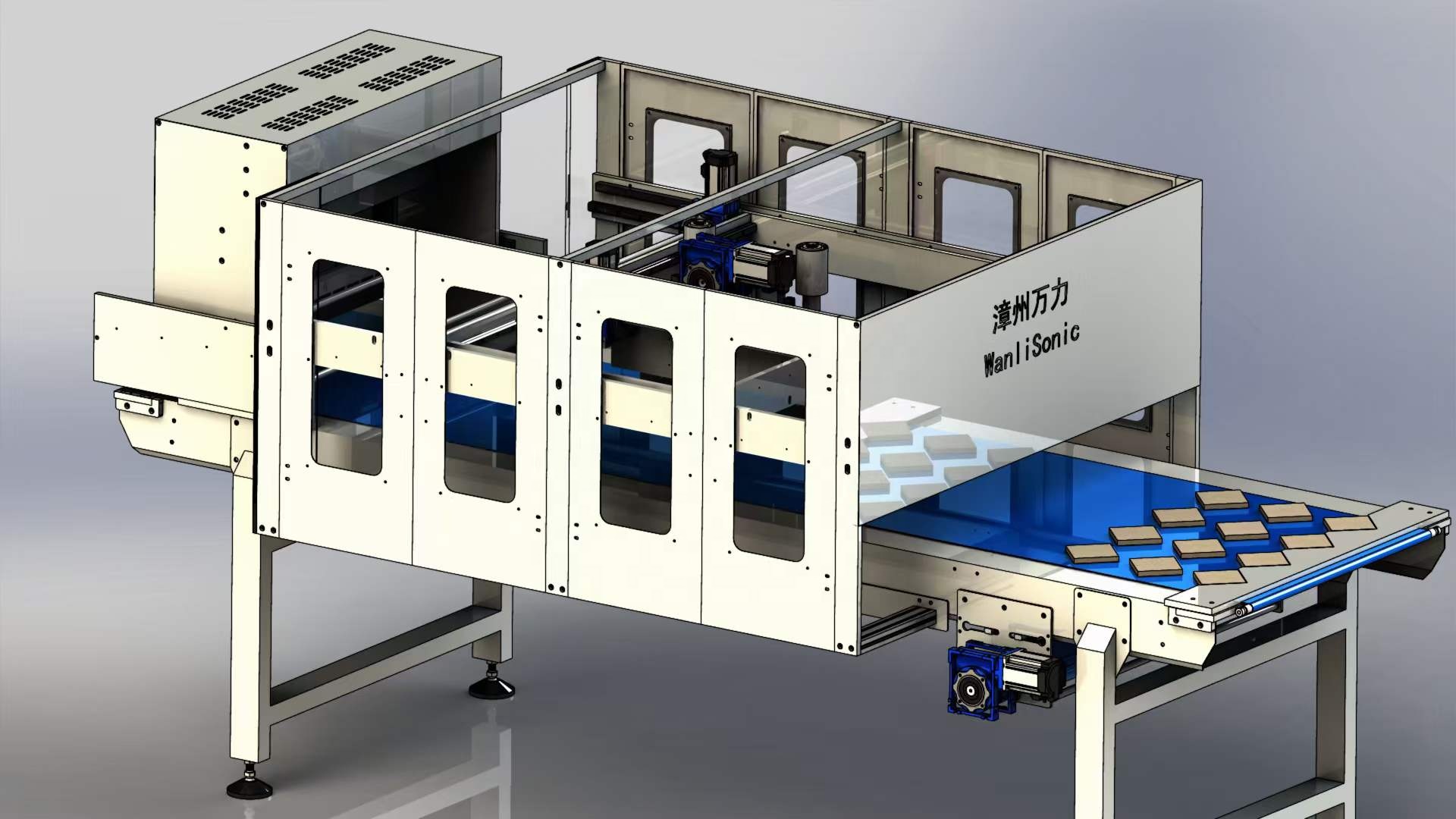
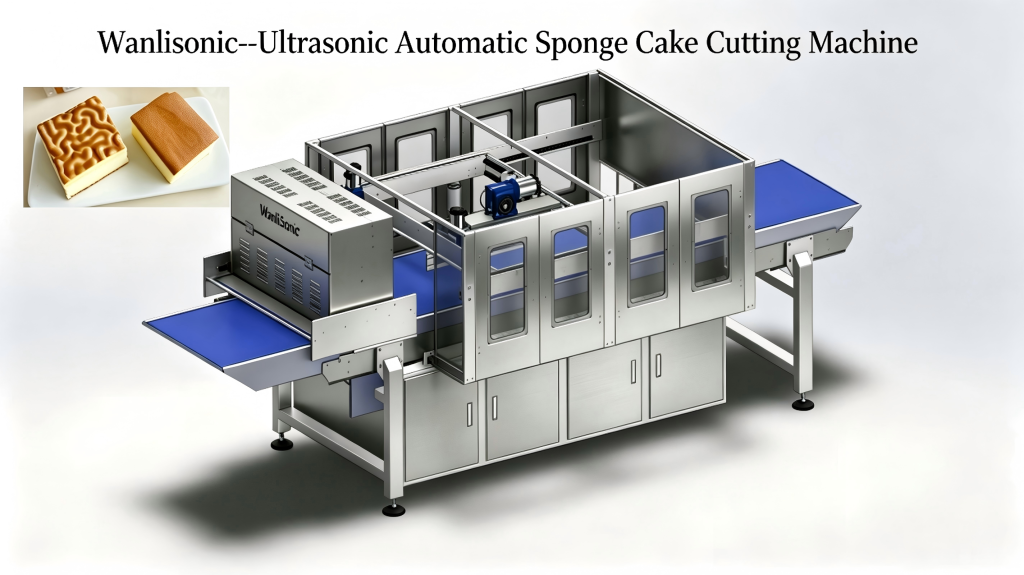
The machine works either as a standalone unit or as a station inside an existing production line. On refined configurations, Wanlisonic uses a 5-axis servo motor system and automatic belt conveying, allowing products up to 400 × 600 mm to be cut after leaving a chain slatted tunnel oven — removing the manual handling that normally limits cake cutting capacity.
A typical automated flow runs:
- Cakes are loaded onto the conveyor after baking and cooling
- Product is positioned automatically according to the programmed pattern
- The ultrasonic blade performs the selected cut — round, strip, square or triangle
- Cut portions are separated and transferred onward
- Finished portions continue to packing or further processing
Because the machine works with traditional-type food production lines as well as standalone, bakeries can introduce ultrasonic cutting without rebuilding the plant around it.
Preserving Cream, Mousse and Layered Structure
Products carrying cream, jam, chocolate or mousse are where ultrasonic cutting shows its clearest advantage. The blade does not stick to these materials, so fillings are not dragged across the cut face and layers do not bleed colour into one another, leaving a smooth and attractive surface — which matters most for premium products where presentation drives the purchase. For frozen and chilled cakes the same principle applies without the cracking and surface damage mechanical blades tend to cause.
Hygiene and Maintenance
Food safety requirements in cake production are strict, and ultrasonic equipment supports them in a practical way. Because the blade surface resists product adhesion, it is far less prone to carrying bacteria than a conventional knife, and the cut face of mold-prone products is not exposed to contamination from a blade needing repeated disinfection. Stainless-steel construction simplifies sanitation, and Wanlisonic machines align with FDA, CE and HACCP requirements.
Customized Solutions and Product Testing
Cake specifications vary widely — diameter, height, texture, filling, required thickness and portion weight all influence the machine configuration. Wanlisonic’s engineering team evaluates product details including dimensions, photos or videos, cutting thickness, portion size and required capacity before recommending a configuration, and product testing on customer samples is recommended before the specification is confirmed.
More Than 20 Years in Ultrasonic Food Cutting
Wanlisonic specialises in ultrasonic food cutting technology, with more than 20 years of manufacturing experience, an in-house R&D team and global after-sales support. Its machines are used by more than 1,000 clients and exported to Europe, the United States, the Middle East, Southeast Asia, Oceania and other markets, across cake, bread, sandwich, cookie, cheese, confectionery and frozen food applications.
Conclusion
As bakeries widen their product ranges and compete on presentation, the cutting station has become a strategic part of the line rather than an afterthought. The Wanlisonic Ultrasonic Cake Cutting Machine brings four cutting modes, ±1 mm portion accuracy, automated positioning and conveyor-based feeding into one platform — delivering cleaner cuts, consistent portions and lower labour input for commercial and industrial cake production. For bakeries planning to consolidate several formats onto a single automated cutter, the new demonstration video shows precisely how the machine performs.
FAQ
1. What is an ultrasonic cake cutting machine?
It is an automated cutting system that uses a blade vibrating at high frequency (typically 20 or 30 kHz) to separate cake with minimal friction, producing clean cuts without crushing or smearing.
2. How many cutting modes does the Wanlisonic cake cutting machine offer?
Four: round slice, strip slice, rectangle slice (square) and rectangle slice (triangle). The operator selects the mode, and the machine positions and slits the product according to pre-inputted parameters.
3. How accurate are the cut portions?
Wanlisonic cake cutting machines achieve dimensional accuracy of around ±1 mm, with cutting speeds of 60 knives per minute on standard configurations and adjustable speed and angle settings.
4. Can it cut cakes with cream, mousse or jam fillings?
Yes. The ultrasonic blade does not stick to sticky fillings and does not drag them across the cut face, so layers stay separate and the cut surface remains smooth and attractive.
5. Can the machine be integrated into an existing cake production line?
Yes. It works as a standalone unit or in line with traditional food production equipment, with automatic belt conveying and configurations that handle products up to 400 × 600 mm, including connection after a tunnel oven.
6. Can Wanlisonic customize the machine for our cake products?
Yes. Cutting configuration is determined by cake dimensions, texture, filling, cutting thickness, portion size and required capacity. Wanlisonic recommends product testing on customer samples before the final specification is confirmed.
Contact Information:
Annie (Senior Customer Consultant)
Email: sales3@wanlisonic.com
Tel / WhatsApp / WeChat: 0086-1588-0521-772