Introduction: How Can Bakeries Achieve Perfect Swiss Roll Slices?
Swiss roll cakes are popular bakery products known for their soft sponge texture, attractive spiral patterns, and delicious cream or jam fillings. However, cutting Swiss rolls into uniform portions can be challenging, especially in large-scale production. Traditional cutting methods may compress the sponge, deform the roll, cause filling to stick to the blade, or produce uneven cutting surfaces.
How can bakeries overcome these challenges while maintaining high productivity and consistent product quality?
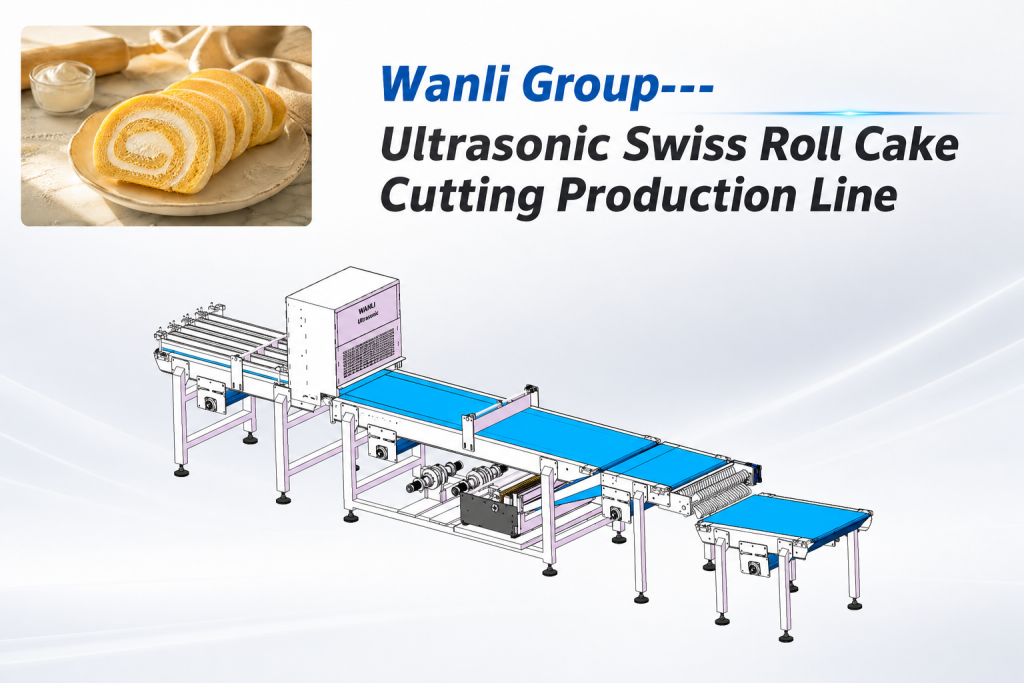
The Wanli Group Ultrasonic Swiss Roll Cake Cutting Production Line, featuring advanced ultrasonic cutting technology, offers an effective solution for modern bakery manufacturers. Under the Wanlisonic brand, Wanli Group develops food-cutting equipment designed to help bakeries achieve clean cuts, reduce product deformation, and improve production consistency.
By combining ultrasonic cutting technology with automated handling, this solution helps food manufacturers optimize their Swiss roll processing operations and meet the growing demand for attractive, consistently portioned bakery products.
1. Why Is Swiss Roll Cake Cutting So Challenging?
Swiss rolls have a different structure from many conventional cakes. Their soft sponge layers are rolled around cream, jam, chocolate, or other fillings. This combination creates several challenges during portioning.
Soft sponge can be easily compressed. Excessive pressure from a conventional blade may flatten the cake or damage its spiral structure, affecting the appearance of the finished slices.
Sticky fillings can adhere to cutting blades. Cream and jam may accumulate on the blade during repeated cutting operations. This can lead to irregular surfaces, additional cleaning requirements, and inconsistent product presentation.
Uniform portion sizes are difficult to maintain manually. Manual cutting relies heavily on operator skill and concentration. As production volumes increase, maintaining consistent slice thickness and appearance becomes more difficult.
Labor requirements can limit production efficiency. Manual positioning, cutting, and handling take time and may create bottlenecks in a busy bakery.
For manufacturers supplying supermarkets, cafés, catering companies, and packaged dessert distributors, these challenges can affect both product quality and production costs.
The Wanlisonic ultrasonic Swiss roll cake cutting solution is designed to address these issues through controlled cutting and automation.
2. How Does Wanlisonic Ultrasonic Cutting Technology Work?
Ultrasonic food cutting uses high-frequency mechanical vibration to help a specially designed blade pass through food products with reduced resistance.
The ultrasonic generator supplies electrical energy to the transducer, which converts it into mechanical vibration. This vibration is transmitted to the cutting blade, allowing it to cut through soft sponge, cream, and other suitable fillings more smoothly than conventional cutting methods in many applications.
When the vibrating blade moves through a Swiss roll, the reduced cutting resistance helps minimize compression and material adhesion.
The main advantages include:
- Cleaner cutting surfaces: The vibrating blade helps produce smooth, attractive cut faces.
- Reduced deformation: Lower cutting resistance helps preserve the original shape of delicate Swiss rolls.
- Less material sticking: Ultrasonic vibration can reduce the tendency of sticky fillings to adhere to the blade.
- Improved portion consistency: Controlled cutting movements help produce more uniform slices.
- Reduced product waste: Cleaner cutting may help minimize damaged portions and unnecessary trimming.
Actual results depend on the cake recipe, sponge structure, filling characteristics, temperature, product dimensions, and machine settings. For this reason, Wanlisonic recommends evaluating representative product samples before confirming the final machine configuration.
3. How Does an Ultrasonic Swiss Roll Cake Cutting Production Line Support Automation?
For industrial bakeries, cutting performance is only one part of the production process. Manufacturers also need reliable product handling, efficient operation, and consistent output.
An ultrasonic Swiss roll cake cutting production line can integrate controlled feeding, product positioning, cutting, and finished-product handling according to the customer’s requirements.
Controlled Product Feeding and Positioning
Consistent feeding is essential for accurate cutting. Products must enter the cutting area in a suitable position so that the machine can perform the required portioning operation.
Depending on the selected configuration, automated conveying and positioning can help reduce repetitive manual handling and support a more organized production workflow.
Precise Ultrasonic Portioning
The cutting system divides Swiss rolls according to the required portion dimensions and cutting pattern. Appropriate parameters can be configured for the product being processed.
For bakeries producing multiple product sizes, confirming the required roll diameter, length, slice thickness, and production capacity helps determine the most suitable cutting arrangement.
Organized Finished-Product Handling
After cutting, finished portions need to be transferred carefully for packaging or subsequent processing. The handling method should protect the appearance of the slices and suit the customer’s existing production layout.
Where required, additional functions such as paper inserting, collection conveyors, or connections to downstream packaging equipment can be evaluated as part of a customized solution. Their availability depends on the specific machine configuration.
By coordinating these stages, Wanlisonic helps manufacturers explore practical automation options that fit their production requirements.
4. What Benefits Can Bakeries Gain from the Wanli Group Solution?
Better Product Appearance
Swiss roll slices are often displayed with their spiral patterns clearly visible. Smooth cut surfaces and well-preserved shapes make products more attractive to consumers.
Ultrasonic cutting helps reduce the crushing and smearing that may occur when soft cakes are cut using conventional methods, supporting a more professional finished appearance.
More Consistent Portion Sizes
Uniform portions are important for packaged desserts, retail distribution, and food-service applications. Automated cutting can improve repeatability compared with fully manual operations when the product is positioned consistently and the machine is correctly configured.
This helps manufacturers maintain clearer portioning standards and improve the consistency of finished products.
Improved Production Efficiency
Manual cutting can become a bottleneck when production volumes increase. Automation reduces the need for operators to perform every cutting step manually and can help streamline the workflow.
The actual production capacity depends on the number of cutting positions, product dimensions, cutting pattern, feeding arrangement, and other operating conditions. Customers should confirm their target output with the Wanlisonic engineering team.
Reduced Cleaning and Product Loss
Sticky fillings can create cleaning challenges in traditional cake cutting. Ultrasonic vibration may reduce blade adhesion, helping improve cutting performance and reduce interruptions caused by product buildup.
Better cutting quality can also help reduce the number of portions rejected because of poor appearance. However, appropriate cleaning procedures and food-safety practices remain essential.
Greater Production Flexibility
Different bakeries produce Swiss rolls with different dimensions, fillings, and portion requirements. A suitable cutting solution should be selected according to the products and production objectives rather than relying on a single standard configuration.
Wanlisonic can evaluate customer requirements to determine whether a standard machine or a customized arrangement is more appropriate.
5. Which Swiss Roll Products Can Be Processed?
Ultrasonic cutting is suitable for evaluating a range of Swiss roll products, including:
- Traditional sponge Swiss rolls with cream filling.
- Jam-filled Swiss rolls.
- Chocolate Swiss rolls.
- Soft sponge rolls with other suitable fillings.
- Commercially produced Swiss rolls requiring uniform portion sizes.
Different recipes behave differently during cutting. For example, a chilled cream filling may have different cutting characteristics from a soft filling processed at room temperature.
Before equipment selection, manufacturers should provide product samples or representative videos, together with the roll dimensions, filling type, product temperature, required slice thickness, and expected output.
These details help Wanli Group assess cutting feasibility and recommend appropriate equipment settings.
6. How Does Wanlisonic Support Food Manufacturers?
Wanlisonic focuses on ultrasonic food-cutting equipment for bakery and food-processing applications. With experience in food machinery manufacturing, Wanli Group provides equipment solutions for products that require precise cutting and careful handling.
Rather than treating every production requirement as identical, the company evaluates the customer’s product characteristics and processing objectives when developing a suitable solution.
For Swiss roll cake manufacturers, important considerations include:
- Product dimensions and shape.
- Sponge softness and filling characteristics.
- Required portion thickness and cutting accuracy.
- Target production capacity.
- Available factory space and conveyor layout.
- Cleaning requirements and downstream packaging arrangements.
Confirming these factors before production helps ensure that the selected machine matches the customer’s actual application.
For manufacturers planning to upgrade an existing bakery line or develop a new automated production process, early technical communication can also help identify integration requirements and avoid unnecessary equipment changes later.
7. Why Choose an Ultrasonic Swiss Roll Cake Cutting Production Line?
As bakery markets become more competitive, manufacturers need to balance product appearance, production efficiency, labor requirements, and operating costs.
Traditional cutting methods may remain suitable for some products and smaller production volumes. However, when soft sponge cakes and sticky fillings create recurring cutting problems, ultrasonic technology is worth evaluating.
The Wanli Group Ultrasonic Swiss Roll Cake Cutting Production Line combines the advantages of ultrasonic cutting with opportunities for automated handling. It is designed to help manufacturers achieve cleaner slices, preserve delicate cake structures, improve portion consistency, and streamline repetitive processing tasks.
The most suitable solution depends on the product itself and the customer’s production goals. Testing actual Swiss rolls and confirming the required specifications are important steps before final equipment selection.
For bakeries looking to improve Swiss roll cutting quality and explore more efficient production, Wanlisonic offers a practical starting point for evaluating an ultrasonic cutting solution tailored to their needs.
FAQ—Ultrasonic Swiss Roll Cake Cutting Production Line
Q1: What is an ultrasonic Swiss roll cake cutting machine?
An ultrasonic Swiss roll cake cutting machine uses a high-frequency vibrating blade to cut delicate Swiss rolls with reduced cutting resistance. It is designed to help achieve smooth cut surfaces while minimizing cake deformation and filling adhesion.
Q2: Can ultrasonic cutting prevent Swiss roll cakes from being crushed?
Ultrasonic vibration helps reduce the force required for cutting, which can significantly reduce compression in suitable products. However, results depend on the sponge texture, filling, temperature, and machine settings.
Q3: Can the machine cut Swiss rolls with cream or jam fillings?
Yes. Ultrasonic cutting can be suitable for Swiss rolls containing cream, jam, chocolate, and other compatible fillings. Product testing is recommended to confirm the best cutting conditions.
Q4: Can the production line be customized?
The equipment configuration can be evaluated according to product dimensions, cutting requirements, production capacity, and factory layout. Optional functions and production-line integration should be confirmed with the Wanlisonic engineering team.
Q5: How can I confirm whether the machine suits my Swiss roll products?
Provide the product dimensions, filling type, required slice thickness, target output, and product photos or videos. Sending representative samples for cutting tests can help evaluate the results before ordering.
Q6: How can I obtain a quotation for a Wanlisonic Swiss roll cutting production line?
Contact Wanlisonic with your product specifications and production requirements. The sales and engineering teams can assess your application and recommend a suitable configuration and quotation.
Contact Information
Mia Wu (Senior Customer Consultant)
Email: sales1@wanlisonic.com
Tel / WhatsApp / WeChat: +86 15759607601